The Noise Point
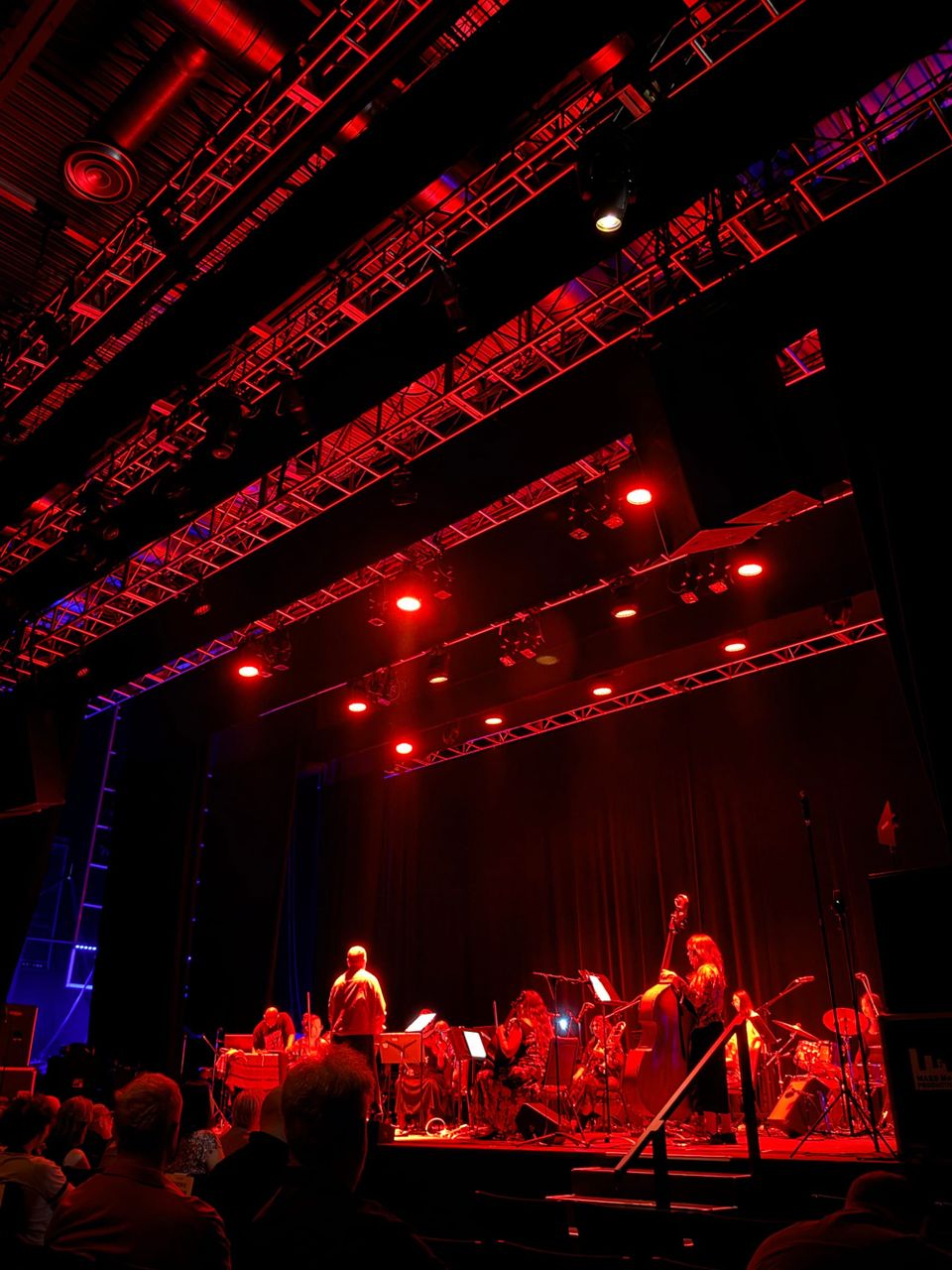
In Review: Bang on a Can’s LOUD Weekend at Mass MoCA
There is a point where all genres of music, pushed to the extreme, converge. Call it horseshoe theory for sound: Orchestral polyphony multiplies to the point that the lines blur together, jazz solos depart ever further from their themes, electric guitarists pile up distortion effect upon distortion effect with an ocean of switches and pedals. The point where they meet is the noise point, the point where musical logics fall away and we find ourselves left with raw sound in a visceral, seething mass, unconstrained by the intermediaries of pitch, rhythm, duration, and timbre.
The works presented at Bang on a Can’s LOUD weekend at Mass MoCA paid many visits to that point, drawing near it from every direction. The necessities of sleep and shabbes precluded me from catching Thursday’s late show or anything after 6:30 on Friday evening, but even the “mere” five-plus hours of music I caught was enough to leave my head brimming with sonic energy for days afterward.
Consider Rohan Chander’s Scenes from American Primitivism, a three movement work for large chamber ensemble that blent extended techniques and electronically distorted vocal samples into a death-metal maelstrom condemnation of racism and fetishization — one of the only clearly audible vocal samples is a quip that European audiences are only interested in non-Western art insofar as it taps into a “primitive” aesthetic. Dominykas Digimas’s Albedo, meanwhile, came at static from the other end, slowing down its text about journeying into light until the words themselves decomposed to leave room for the strings to play their instruments with the sides of their bows in a swirling, hissing ecstasy.
Both works were premiered on Friday’s “Newest Voices” concert, which presented works by eight young composers written for more than twenty performers, all of whom had been in residence for weeks of study, mentoring, and developmental rehearsals and performances. Bang on a Can may still have their iconoclastic, mold-breaking energy, but they’ve achieved enough staying power to become guides for a new generation.
Not every piece on the program reached the point of dissolution. Slow Burn, a rollicking offering from Sami Anguaya, kept itself anchored in a propulsive, asymmetrical groove, and Benjamin Webster’s partimento — named after an old genre of composition exercise where a teacher would write one musical line and have the student fill in the others — clung to a glittering ostinato in the piano and pitched percussion as the rest of the ensemble wove their own contrapuntal lines around them, building to a coldly mechanical triumph utterly devoid of joy before melting into a spangled wonderland at the finish. Gideon Broshy’s Law of Touching had some of that momentum but without the solidity, assembling gestures, lines, and textures from scattered points welded together, only to have them disintegrate just as quickly.[1]
Rounding out the program were Morgan Harrington’s tarot-inspired Six of Swords, which depicted an emotional journey from turbulence to ease by means of oceanic swells that emerged with mysterious independence from the surface details of the music; Michaela Rea Catranis’s luminous hymn to the exquisite beauty woven into the world around us at every moment, wait, wonder waits; and Revelations, a disquieting aria by Emelia Ulrich in which a housewife slowly realizes her husband is planning to incapacitate her by means of involuntary surgery.
Ulrich’s offering was just one of several operatic works in the lineup. The weekend opened with David Lang’s Death Speaks, a sequel of sorts to his 2007 little match girl passion that had soprano Freja Højland Høj offering Death’s sales pitch (of sorts) for the afterlife using text derived from the thirty two Schubert songs where the Grim Reaper has a speaking role. With frigid soundscapes and pinpricks of light[2], Lang convincingly captured the double-edged relationship with death — as both a tragic end to life and the yearned-for gateway to Heaven — evinced in the 1830s source poetry; I think it is a personal failing on my part that I am so turned off by the entire Christian spiritual apparatus that I struggled to enter its rhetorical world. Saturday, meanwhile, saw the world premiere of Annie Gosfield’s Emma, a cantata-like bio-opera of iconic anarchist Emma Goldman (with a libretto drawn from the latter’s autobiographical writings).
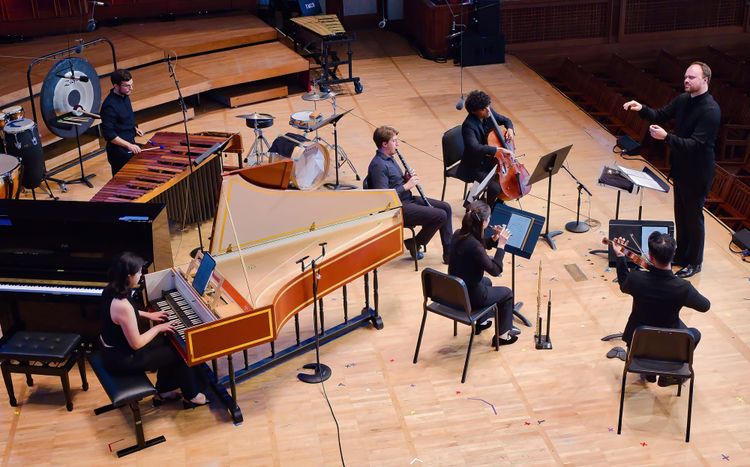
Emma is scored for voice and percussion sextet — here the sardonically mercurial Eliza Bagg and Mantra Percussion, who delivered the hour-long score with unflagging ritualistic reverence and intensity — an unpromising combination, especially given LOUD weekend’s practice of subtly amplifying most performances. I was pleasantly surprised, then, to find that Gosfield pulls a compositional magic trick here, managing to keep the textures simultaneously fresh and balanced for the entire run: Goldman’s journey to Rochester is propelled by loping tom-toms; her momentary blank-faced stage fright before a key speech is deftly haloed by disorienting metallic shimmers. All this excellence makes the libretto a bit of a let-down. Writing about herself, Goldman defaults to high-level narrative instead of real-time scenes: She tells us that she pleaded with her father to go to America, but we don’t actually get the content of her plea. This makes for a breezy memoir, but is less effective on stage — it’s one thing to be told that after recovering from her bout of stage fright, she delivers a fiery speech that gets the crowd on their feet, but it’s quite another to get to experience those rhetorical pyrotechnics for ourselves.
If you wanted to see what else Gosfield could do after that, you were in luck: One of the following concerts featured her Overvoltage Rumble — a delightfully yawpy work that included ecstatically gloopy analog synth samples and a truly virtuosic monologue for double-stopped double-bass (played with deep earthiness by Zoe Markle) — alongside two pensive Kafka-derived works (The Bucket Rider and BE JUST!) by Martin Bresnick. If you wanted more percussion, you could get that, too: Another concert presented percussion quartets by Shelley Washington, Raven Chacon, and Marc Mellits. Washington and Mellits’s quartets were both scored for two marimbas and two vibraphones, with hers, Sunday, being a wistful meditation on the loss of the early covid pandemic and the retrospective rosy glow it cast over even mundane pre-shutdown memories, and his, Gravity, being a study in asymmetrical ostinatos and hammering acceleration. Chacon’s work, Music for Voice, was the odd one out, featuring all four percussionists standing in a spaced-out row, each standing behind their own individual gong. As they rubbed the gongs with rubber mallets to elicit uncanny screeches and moans, the players opened their mouths and shaped their expressions as though the sounds we were hearing were emerging from their throats instead. The effect was sensuous, even erotic — I say in full positive sincerity that several times I thought “Oh so that’s what it would look like for someone to get head from a percussion instrument!”. What a relief that the forces of puritanical censoriousness have not yet succeeded in their abominable goal to eradicate all the luscious, weird intensity of the full human experience![3]
The percussion concert ran long — an inevitability for a festival with as many simultaneous moving parts as this one — so I was only able to catch the final work on the Chacon spotlight that followed it, The Journey of the Horizontal People for string quartet. While still scored for four performers, it was about as far as you could get from Music for Voice: skittery, brittle, always clinging to the very cusp of silence.
I was unable to catch the Bang on a Can All Stars’ live recreation of Terry Riley’s Rainbow in Curved Air, but I did manage to catch their take on Philip Glass’s Glassworks. One of Glass’s breakthrough works in the early 80s, the six-movement suite displays most of the composer’s hallmarks, for good and ill. There are, to be sure, moments of turgid arpeggios that drag, but there are also moments where the music cuts right to the deepest center of your heart using the barest of materials and the simplest repetitions. Even the moments that I find a little underwhelming on the album were carried live by the exhilaration of watching these musicians play in real time — could Lizzie Burns and Arlen Hlusko really be moving their bows and fingers that fast? Could Ken Thomson really be going that long between breaths on bass clarinet?
Glassworks’s final movement ends with the other instruments falling away, returning to the solo acoustic piano with which the piece opened some forty minutes before. Left all alone, Vicky Chow gave the closing measures the air of some long-lost Beethoven slow movement, at once ancient and eternally relevant. Played on the weekend’s opening night, the quiet little gesture felt like a cosmic benediction: May all that is now new endure to one day become old.
Full disclosure: Broshy and I met in college, and our professional and social lives have continued to intersect at various points since then. Additionally, I’m also collegial friends with Shelley Washington, Caitlin Cawley, and Mika Godbole, all of whom had some hand in various works discussed below. ↩︎
In addition to voice, Death Speaks is scored for violin, piano, and electric guitar, here played by Juliana Pöyry, Ricky Moreira, and Taylor Levine, respectively. ↩︎
I worry that this sounds sarcastic. I promise I do mean it in absolute earnest. More art that doesn’t shy away from the physicality of flesh, please! ↩︎
In Brief
I neglected to mention this in last week’s Tanglewood roundup, but if you, like me, were unable to make the complete performance of Glass’s piano etudes and want to catch up on what you missed, you could do worse than Sally Whitwell’s complete recording. If you just want to dip your toes in, why not start with the pokey, humorous number 10?
Keep your eye out for a more formal review later this month, but bassoonist Rebekah Heller has released a brand new album for multi-track bassoon just last week, and suffice it to say that it’s well worth your time. In keeping with the title, there’s plenty of harsh, aggressive music on the disk, but there are also moments of expansive, introspective repose. (You can also stream the whole thing for free on YouTube, but if you really want to support new music, one paid download on Bandcamp is worth thousands and thousands of streams.)
Just this morning I put on James McVinnie’s Dreamcatcher album and was immediately taken with the barnstorming opening track by Gabriella Smith. There’s plenty of other juicy goodness on the rest of the album, ranging from Giles Swayne’s off-kilter Riff-raff to a wonderfully ethereal rendition of John Adams’s China Gates.
Member discussion