More Cowbell
And we’re back! Thanks all for your patience as I took time off for this dense month of holy days. Regardless of whether you yourself marked any religious observances, I hope these past weeks have been full of moments for joy, deep connections with loved ones, and plenty of excellent food.
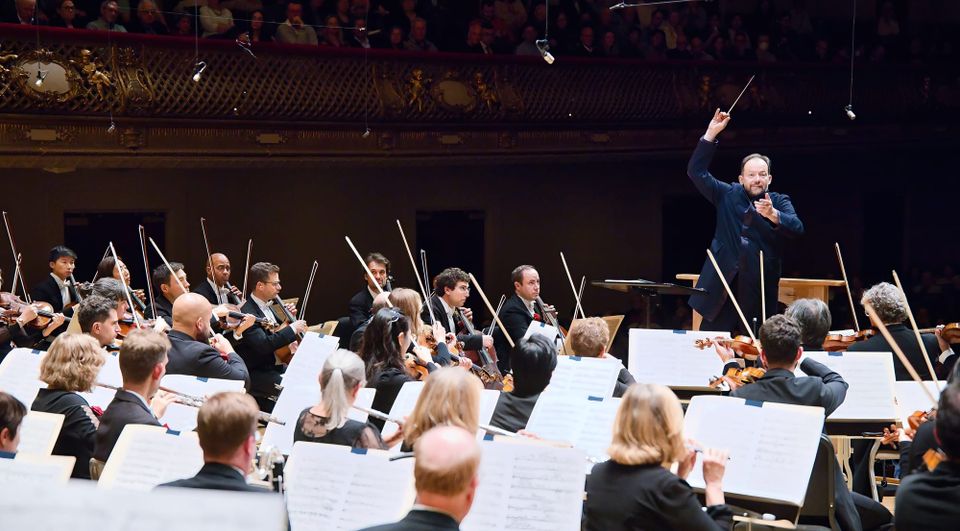
In Review: Gubaidulina and Mahler at the BSO
There’s something fitting about Sofia Gubaidulina’s final work being a prologue. The composer, who died last year at the age of 93, was devoutly Russian Orthodox and suffused her music with the intensity of her faith; insofar as Christianity treats earthly existence as the prelude for an infinite afterlife, it feels right that the end, for her, should be labeled a beginning.
In truth, Prolog — commissioned by the Boston Symphony and Gewandhaus Orchestras, premiered by the BSO under the baton of Andris Nelsons on September 24th — is not Gubaidulina’s work alone. Although she began working on this prelude to her Wrath of [G-d] in 2020, she only finished about a quarter of the ultimate work before she died. The completion, based on her notes and sketches, was done by her longtime friend Elena Firsova.
The result is a monument of aching intensity. Boiling masses of sound seethe away into isolated tones like wine in a hot skillet reducing down into an ultra-concentrated glaze; hymnic chords echo Orthodox chant before rotting into nauseating mush. Its brooding landscape spoke of despair and grief — I will not pretend to know everything Gubaidulina and Firsova felt and feel about the country of their births, but I was put in mind of certain thoughts I have had about America: loving what I believe it could be, despising what it has become, dreading that the horrors were baked in from the start, their emergence as inevitable as flies from putrid meat.
Prolog clocks in at twenty-ish minutes, but it’s hefty enough to anchor an entire program, and I hope to hear it again in a concert where it’s not competing with an entire Mahler symphony for attention. Gustav Mahler’s seventh entry in the genre may be my favorite of the lot, but it takes up space and demands considerable attention.
My regard for isn’t universal — plenty of critics find it kitschy and unconvincing. Nelsons seemed intent on rescuing the work from such charges on Thursday, leading a decorous, polished performance that kept a tight lid on Mahler’s gonzo exuberances.
This worked well in the second and fourth movements: I have never heard a finer rendition of the former, with its oceanic swells, and his quick tempo in the latter gave it an unexpected balletic grace. But the other movements suffered. The ethereal interpolation of the first movement lost its poignant contrast without the frenzy of the surrounding march; in avoiding campy spookiness, the scherzo avoided definition too; when the cowbells crashed the party in the finale’s climax, they decorously thickened the texture instead of thwacking us directly into the thick of a bovine herd.
Going for broke here can be déclassé, but so what? Life cannot all be politesse; sometimes you simply must romp around in the mud. Mahler, I think, new the preciousness of sheer dumb fun, the way it can seize you unexpectedly even in times of great tragedy, how vital it is to chase after it — because my G-d is there suffering enough in life. His works certainly evince that, at any rate. There’s sorrow in them, but there’s goofiness, too, and that, as much as his anguish, deserves to be played to the hilt. Joy is not meant to be a crumb.
In Brief
For a contrasting take on this BSO performance, check out Jeffrey Gantz over in the Boston Musical Intelligencer. Among other things, he seems rather less taken by Mahler 7 overall than I am, but rather more convinced by the evening’s rendition of it, and he also dives more into the theological background of Prolog. A useful reminder of how subjective this criticism business is!
For secret reasons, I’ve been doing a deep dive into various far-flung corners of the bassoon repertoire, which this past week included Miguel del Aguila’s Hexen for bassoon and strings. I still regularly encounter people who think the bassoon is only good for buffoonery, so I’m always excited about pieces that play against that image; I’m especially drawn to Hexen in that ragard because it takes so many staples of bassoon “comedy” — bouncing staccatos, ungainly trembles, queasy instability — and weaves them into something deliciously unsettling. Let spooky season commence!
In My Calendar
As ever, these listings aren’t comprehensive, they’re just the ones that happen to have caught my eye and that I have particular interest in. If you’re a local artist, publicist, or presenting institution, please add me to your mailing list so I can keep up to date on what you have going on!
Events marked with a Ø are free and open to the public.
- Ø Oct 8, 7:30pm: New Music New Haven offers a free livestream of music by Christopher Theofanidis. Theofanidis was a huge early influence of mine, and I’m still regularly struck by his ability to summon luminous rhapsody out of very spare, even turbulent materials.
- Oct 10, 7:00pm: The enterprising multi-media event space Epsilon Spires presents an evening of improvisatory drone/electronic music alongside a film by Andrei Tarkovsky. You probably won’t come away humming any tunes, but I still expect it might make a deep impression if you go.
- Oct 10, 7:30pm: Out east, the Second New England School takes center stage under the aegis of Odyssey Opera. The Second New England School composers are a hugely important chapter in the musical history of this country, but they’re seldom heard today for reasons that have more to do with various complex chauvinisms than their actual musical quality, which is generally quite high.
- Oct 10, 8:00pm: That same evening, the Boston Symphony Orchestra gives the third of their US premiere performances of Francisco Coll’s new piano concerto. And, for those of you who don’t want to travel out that far, good news! New England Public Media is live broadcasting the concert, so you can hear it for free in the comfort of your own home. (My local station is 89.3 FM, but you can look for yours on their website.)
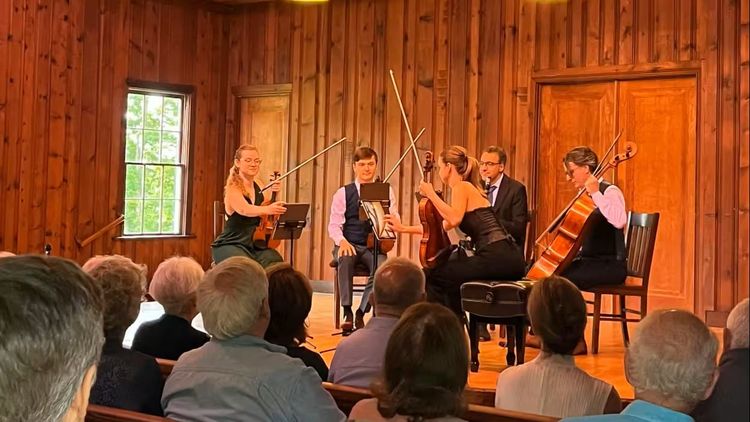
- Oct 11, 4:00pm: The Drake’s chamber music series continues with the Apple Hill String Quartet. No word on the precise repertoire, but their bio on the website hypes the diversity of their offerings, so there’s likely to be a little something for everyone.
- Ø Oct 13, 7:30pm: Speaking of the Second New England School, an Amy Beach theme and variations is part of the lineup for UMass’s first faculty chamber music concert[1]. The whole lineup looks thoroughly delightful to my eye, although I’m always biased when there are double reed trios in the offing.
- Oct 15, 7:00pm: On the folk-ier side of things, Culomba opens their Polyphony Fest at Bombyx with an evening of close-harmony music drawn from traditions spanning multiple continents. Expect dissonances that come to sound like consonances by the end of the night.
- Ø Oct 15, 7:30pm: If instrumental music is more your style, Smith College’s James Limerick Kerr performs a faculty recital on guitar that includes everything from the Renaissance strummings of John Dowland to original works by Kerr himself.
- Oct 15, 7:30pm: Further south, the Hartt School’s Garmany Chamber Music Series continues with Natalie Tenenbaum’s performance of a program titled THE PIANO // RE-IMAGINED. No specific works are mentioned, but I’d still bet there’s at least one piece where she plays her instrument on the inside.
- Ø Oct 16, 7:30pm: Perhaps you, too, have complicated feelings about the United States these days. What does it even mean to “celebrate” the anniversary of this country at this time? Smith College hosts a selection of newly commissioned variations on “America the Beautiful” from a wide array of living composers that may not answer that question, but may still offer some solidarity in the uncertainty.
- Oct 17, 7:00pm: Back in Brattleboro, the Vermont Symphony Orchestra wind quartet takes a globe-hopping tour of music written for their ensemble.[2] It should be a lighthearted evening, but not without substance to the joy.
- Oct 17, 7:30pm: Piano superstar Jeremy Denk comes to Amherst College with a program that includes not only Beethoven’s monumental final sonata but also Unsuk Chin’s fiendish études — and plenty more besides!
- Oct 17, 8:00pm: Also that same evening, the BSO performs a new double concerto by Carlos Simon that features the matchless double header of Hilary Hahn and Seth Parker Woods. NEPM is once again broadcasting the concert, so if you’re feeling like an evening in, turn on your radio and let the music play.
- Oct 18, 3:00pm: Culomba rounds out their time at Bombyx with a concluding performance set to include participants from their close-harmony polyphony workshop. If you couldn’t make their Thursday performance, or if you just can’t get enough of their style, perhaps this one will fit better into your calendar.
Member discussion