The Unsilenced Dead
In Review: Requiem for America at Jordan Hall
The list of outrages committed in this country’s foundational, ongoing genocide of Native Americans is a long one. Just reading out the bare facts of each would take weeks of speaking with no pause. Commemorate them all in music, and you’d be there for decades.
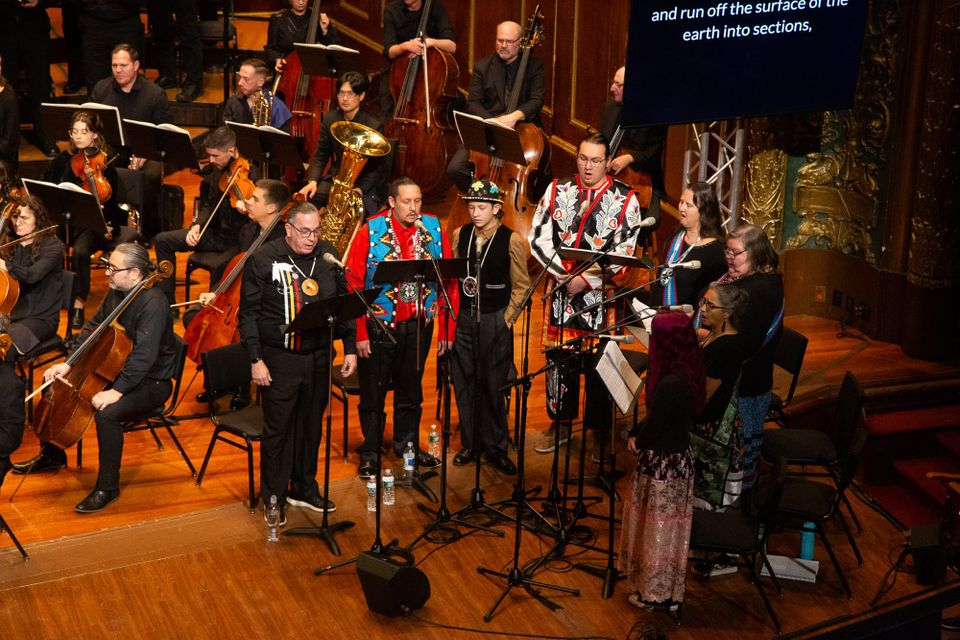
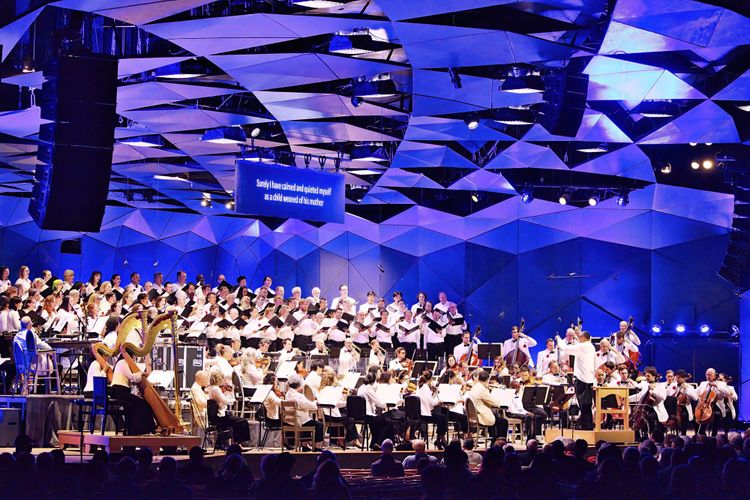
That’s more or less how long it took Brent Michael Davids to compose his new Requiem for America, which received its US premiere on Saturday evening in Jordan Hall in a production by White Snake Projects. Without aiming for encyclopedic completion, Davids’s work compiles a litany of nearly twenty atrocities, setting primary sources of the events in a sweeping indictment of US history that encompasses centuries of time and a continent of space. Scored for Native American flute (here played by Davids himself), five vocal soloists, Native chorus,[1] European chorus,[2] and orchestra, this monumental work overflows with rage, grief, and unshakable determination to survive.
Each of the nineteen movements is named after a section of the traditional requiem text and takes a similar form: the contralto soloist (here the lusciously rich Sara Couden), personifying Earth, provides a quick historical introduction to the given horror, whereupon one or more of the other vocal soloists (frequently in concert with the European choir) step into the role of historical personages and sing out the movement’s primary source accounts, with the Native chorus occasionally adding their own interjections — an Ojibwe love song here, a hymn to creation there — all while the orchestra seethes below. The music itself makes heavy use of quotation and collage, transforming the British national anthem, for example, into a queasy barcarolle, and piling up ironic hymn-tune quotations, traditional Indigenous songs, and original music in grindingly uncompromising juxtaposition.
The complexity isn’t always that extreme — there are plenty of passages where the whole ensemble moves as one, as in the loping thunder of the “Benedictus/Guardians Expelled” or the melancholy unwinding of the “Agnus Dei/Bombed for Blankets” — but even when pared back, the music is still filled with bruising intensity. This sets up a tricky balance: While aiming to convey the oppressive weight of the sheer scale of the wrongs it documents, Requiem sometimes tips into a leaden monotony that undermines its visceral vividity.
This leadenness also haunts the bigger picture. As it stands, the work is too long to be done without an intermission, but the break after “Lacrymosa/The Long Walk” palpably sapped the evening’s energy, and the second half took a while to build it back. With some judicious trims (especially of those Earth introductions that duplicate the material they precede), I suspect it could be honed to much more potent single act.
Even so, I didn’t want everything to be shorter. The final movement, “Threnoedia/We Are Still Here” breaks from the pattern. Instead of a historical unearthing, it comprises a polyvocal chant of endurance. In the final moments, the singing ceases, the instruments fall silent, and the only motion on stage comes from three people carrying weights on the end of strings. Swung in rapid circles, these simple devices produce a hollow whistling sound, like wind in desolate valleys. In the still hall, they prolonged this keening for perhaps fifteen or twenty seconds. I could have heard it echo for hours.
This is how the group was credited in the program. As far as I can tell, this sub-ensemble is not an independent organization, but rather an ad-hoc group assembled for this work, here comprising Elizabeth (Lyz) Jaakola, Chris Newell, Darcey St John, Julian Kitto, Vittore Kitto, Xander Ripley-Jaakola, Jagger Ripley-Jaakola, and Maryanna Harstad. ↩︎
The Boston Cecilia, exquisite in diction and ferocious in performance but unfortunately sometimes rather buried by the orchestra in the louder passages. ↩︎
In My Calendar
As ever, these listings aren’t comprehensive, they’re just the ones that happen to have caught my eye and that I have particular interest in. If you’re a local artist, publicist, or presenting institution, please add me to your mailing list so I can keep up to date on what you have going on!
Events marked with a Ø are free and open to the public.
- Ø Until Nov 18, any time: I have not yet had a chance to watch the recording of Saturday’s livestream of Lincoln in the Bardo from the Met, but you can bet your bippy I’ve cleared my schedule to do so before it gets taken down on the 18th. Mazzoli is one of the great opera composers of our time, and the chance to hear her latest work is not to be missed.
- Ø Nov 16, 7:30pm: Various UMass brass ensembles team up for a shared mid-semester concert. Some of the promised composers are old friends, but some are new to me as well. There’s also a livestream link for those who would rather stay in![1]
- Ø Nov 17, 7:30pm: The next day, UMass faculty come together for their second concert of American chamber music this term. There’s a world premiere by one of the faculty composers as well as iconic works by Aaron Copland and Ruth Crawford Seeger.
- Nov 20–22, various times: The Hartford Symphony Orchestra season continues with a program that features Carlos Simon’s Four Black American Dances. I had the pleasure of hearing this set in New York a while back, and can confirm firsthand that they are uproarious fun.
- Nov 21, 2:00pm: The Pioneer Valley Symphony presents an ambitious program that includes multiple contemporary works, a world premiere, and several warhorses of the standard repertoire. There’s a pre-concert talk an hour before the show, and at the performance itself, kids get in free.
- Nov 21, 2:30pm: Further south, the Springfield Symphony Orchestra continues their music director search with an intimate program anchored on Strauss’s four last songs. It’s not the most contemporary lineup, but hearing all the candidates under consideration for the position is sure to be food for thought as their season continues.
- Ø Nov 21, 4:00pm: That same afternoon, the UMass percussion ensemble presents their fall showcase. Does Carl Vine’s Defying Gravity have anything to do with Wicked? Probably not, but there’s only one way to find out for sure...
- Ø Nov 22, 1:30pm: Once again at UMass, their woodwind chamber ensembles present a mixed bill that’s sure to include a good deal of rhythmic play. The rep list is a little vague, but all the listed names are ones I like.
- Nov 22, 3:00pm: Members of the Boston Symphony Orchestra come to Mount Holyoke for a harp-heavy afternoon of chamber music. The advertising for this concert has focused heavily on the premiere of a long-lost piece by Mozart, but I’m much more intrigued by the Jolivet.[2]
- Ø Nov 22, 3:30pm: Elsewhere on the Mount Holyoke campus, the klezmer band an early music program team up for a delightfully oddball double-header that pairs Polish klezmer with the Baroque dances of Telemann. What a juxtaposition!
- Nov 22, 4:00pm: The Drake continues their classical lineup with pianist Jiayan Sun. The website doesn’t list the repertoire, but an e-mailed press release promises everything from Liszt’s virtuosic thunder to Janáček’s mysterious intimacies.
- Ø Nov 22, 4:00pm: Across the river, the Valley Winds perform their first concert of the season. The rep list looks fairly conservative as far as band music concerned, but that still means mostly post-1950s music, so all these things are relative.
- Nov 28, 7:30pm: Epsilon Spires marks the 100th anniversary of Murnau’s epochal Faust adaptation with a screening accompanied by live accompaniment on their historic pipe organ. I’m not entirely sure whether the score will be a contemporary improvisation or a recreation of what would have been played on the film’s initial release — perhaps a combination of both!
Member discussion