Xenoatmospherics
In Review: Helena Tulve at the Yellow Barn music festival
There are coincidences that land with the force of miracles. In the hushed silence that filled the Big Barn in Putney, Vermont, following the US premiere of Helena Tulve’s 2006 setting of Jacob Glatstein’s “In a nakht fun yeridah”, you could hear a single cricket chirping. By pure chance, its little peeps were at almost exactly the same pitch as the singer’s final notes. It was as if the notes had escaped from Melissa Wimbish’s mouth to be sustained by nature itself in the guise of that little bug.
“In a nakht fun yeridah” | “On a night of decline” is a harrowing poem that alludes to the Holocaust without ever referencing it directly, and Tulve sets it harrowingly, for soprano, clarinet, violin, cello, percussion, piano, and accordion (here performed with furious conviction by Wimbish, Nikki Pet, Katherine Yoon, Natasha Brofsky, Matt Boyle, Anna Han, and James Crabb, respectively). The music is skeletal, battered, crushed by an unrelenting weight. At times, it seems unable to continue at all; at others, it explodes with furious, obliterating screams. As the work comes to the final stanza — Gib mir koyekh in der sho fun yeridah,/in mayn sho fun faln un nisht shtaygn./Un nisht shtaygn. | “Give me strength in the hour of descent,/in my hour of falling and not rising./And not rising.” — the music collapses into the depths, each instrument tumbling slowly and inexorably towards the bottom of their range like rotting flesh sloughing off bone. Only the voice holds fast to a sustained pitch: It doesn’t rise, but it doesn’t sink down, either. That stable pitch felt like the smallest possible kernel of defiant hope. Despite its omnipresence, the rot doesn’t eat everything; some small determined human nub endures. It was that fragile, enduring pitch the cricket kept alive.
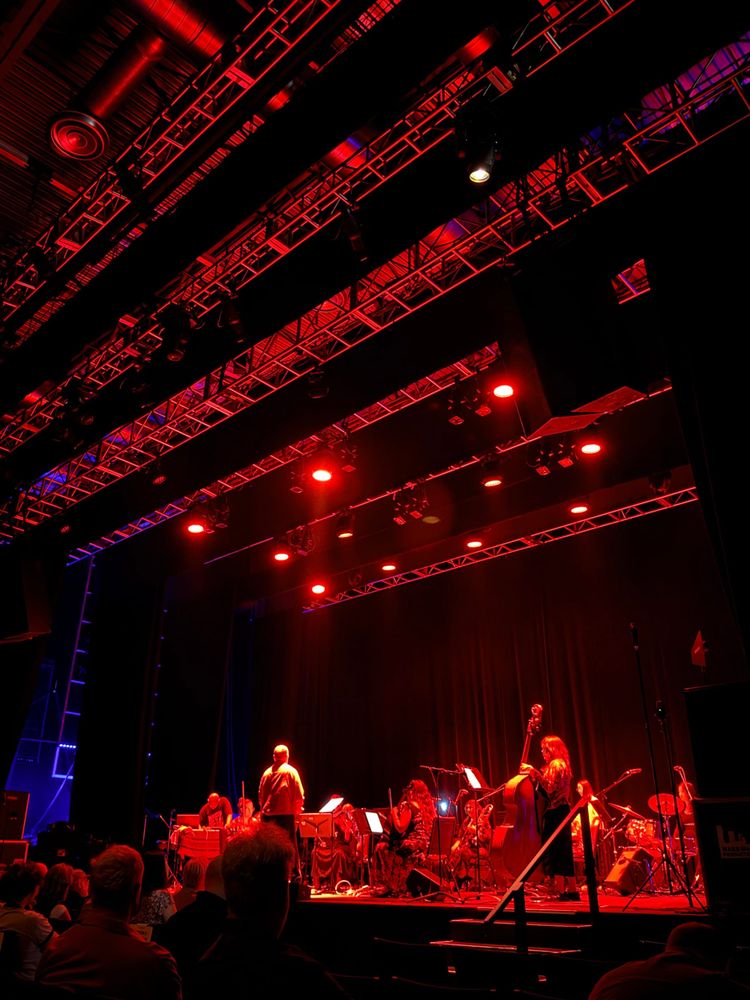
“In a nakht fun yeridah” received its US premiere this past Thursday as part of Tulve’s week-long residency at the Yellow Barn music festival, where her works were presented alongside a plethora of other works old and new in a series of ambitious, smartly programmed evenings. I caught Wednesday and Thursday’s offerings, and came away wishing that my schedule had allowed for more.
Wednesday’s program opened with the world premiere of Farewell, farewell (Music for Paul) (2021), an elegiac work Tulve wrote in memory of her friend and colleague Paul Taub. Scored for flute and piano and here played with mournful grace by Ji Young Kim and Andrew Edwards, Farewell, farewell builds a ghostly, suspended musical world out of sinuous low flute lines and rippling piano textures. Throughout, the two instruments must often function as one, with the piano strings catching the echoes of a loud flute attack and the flute exhaling percussively to emphasize a sharp piano pedal release. Kim and Edwards had such a seamless ensemble blend that their performance seemed to take place on one impossible hybrid flute-piano played by a single mind.
Indeed, this was an experience I had regularly over the two concerts. Performing Kaija Saariaho’s Sombre (2012), Nathaniel Sullivan, Conor Nelson, Eduardo Leandro, Bridget Kibbey, and Noah Daniel merged into a five-part musical hivemind: The bass flute absorbed notes stolen from the baritone voice; the rattle of a double bass sul ponticello arpeggio transformed into the clacking of bamboo percussion chimes — even when at odds, they all seemed to be moving as one. Crabb and Chihiro Asano brought a similar unity to the world premiere of the new version of Tulve’s Mondnacht[1] for accordion and voice, a work that has the singer splutter and gasp as though being strangled while the accordion is all but disassembled for parts. (Han gave a sensitive performance of Schumann’s “Bunte Blätter” immediately following Mondnacht as a kind of surreal endcap returning to the familiar waters of musical Romanticism in the same way that the song’s narrator feels their soul “flying home” at the end; I’m not entirely sure the juxtaposition worked in either piece’s favor.)
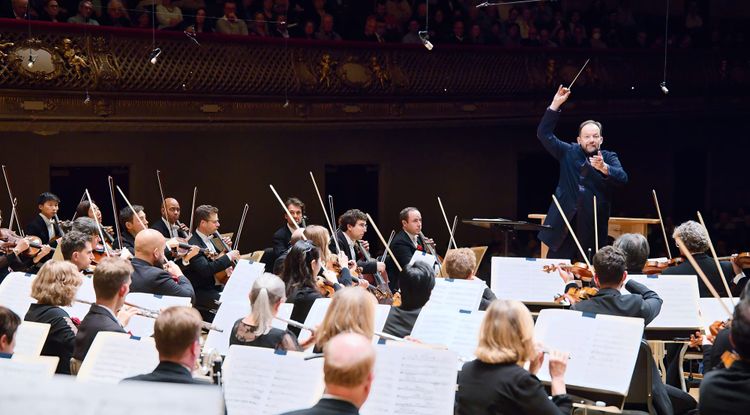
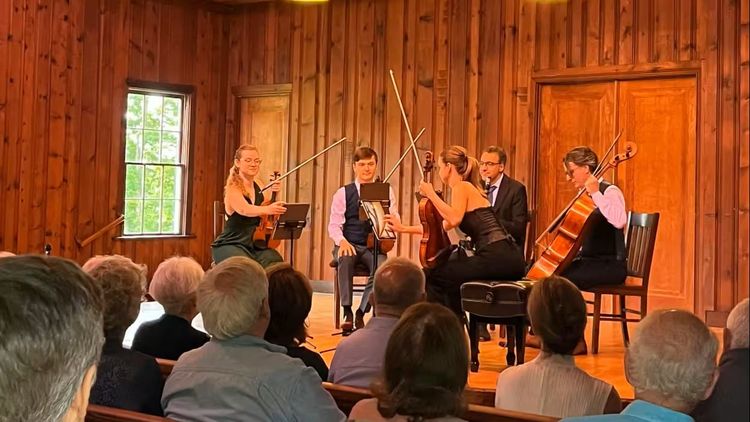
Outside the context of new music festivals, I’ve come to expect programs that put one or two contemporary works in the context of an evening otherwise stuffed with works from the standard repertoire. Here, that practice was delightfully reversed, with the “standard” works being the odd ones out. On Thursday, the chestnut was Detlev Glanert’s orchestration of Brahms’s variations on a theme of Schumann, op 9 (1854, arr 1996), a dinky little piece played with great character and enthusiasm.[2] On Wednesday, it was Mozart’s 14th string quartet, K 387 (1782). After a perfunctory first movement, the musicians[3] settled into their groove in the somber trio of the second-movement minuet and tore through the breakneck finale with barn-burning glee.
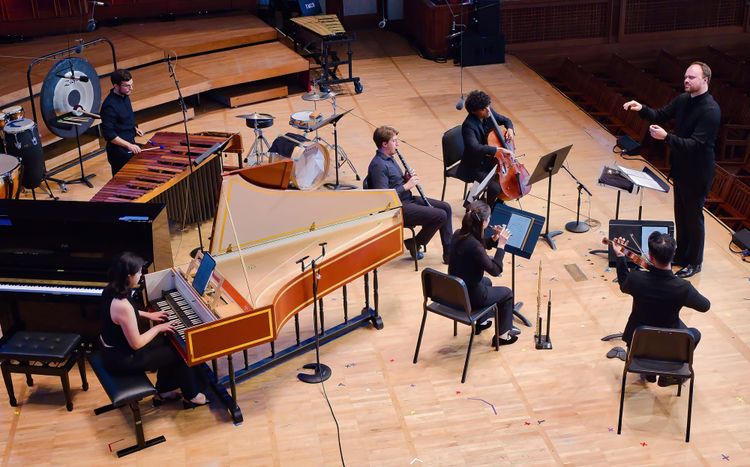
Rounding out each night’s program was a behemoth from the twentieth century. Wednesday brought us Morton Feldman’s Clarinet and String Quartet (1983), which was preceded by a stately rendition of the last contrapunctus from JS Bach’s Art of the Fugue (before 1750), a work quoted obsessively by the Feldman in fragmentary, altered form.[4] The quotes aren’t that hard to identify once you learn to hear them, but it’s hard to say exactly what they’re doing there. Like the rest of the work’s building blocks, they seem resolutely inert, even dead; despite the sharp-edged glint of its ever-shifting chords, the piece feels not unlike trawling through the miasmatic atmosphere of some gas giant, cataloging all the noxious compounds that make life impossible.
As the quintet finished and the audience scattered to intermission, someone behind me groused to their companion, “Jesus Christ that was boring!”. I can’t defend Feldman from the charge; like most of his mature works, Clarinet and String Quartet features a slowly shifting field of isolated, dissonant chords and quavering not-quite- melodies all played at a perpetually hushed dynamic. At forty five minutes in length, the work is short by Feldman standards, but you absolutely do feel every minute of it creeping glacially by. For me, this is much of the point: As there are monumental cathedrals that make you viscerally aware of a volume of space, Feldman makes you feel duration itself; his works are an invitation to let time happen to you. Like the Yom Kipur morning service, the core materials aren’t nothing — the words of the liturgy do mean things, and there are moments in Feldman that break free of the icy stasis to blossom into a desolate, aching warmth — but the sheer mass of those materials takes on a life of its own that works on you independently of the content per se.
(After intermission came James Wood’s Kavalinka Quartet (2017) for four percussionists[5] placed all around the hall. This was the one programming misstep I saw: the quartet is a spare, pensive work full of subtle gestures and ambiguous harmonies. It was performed well, but it called for too much of the same kind of intense focus needed to endure the Feldman marathon. Even with the intervening intermission, the concatenation was exhausting.)
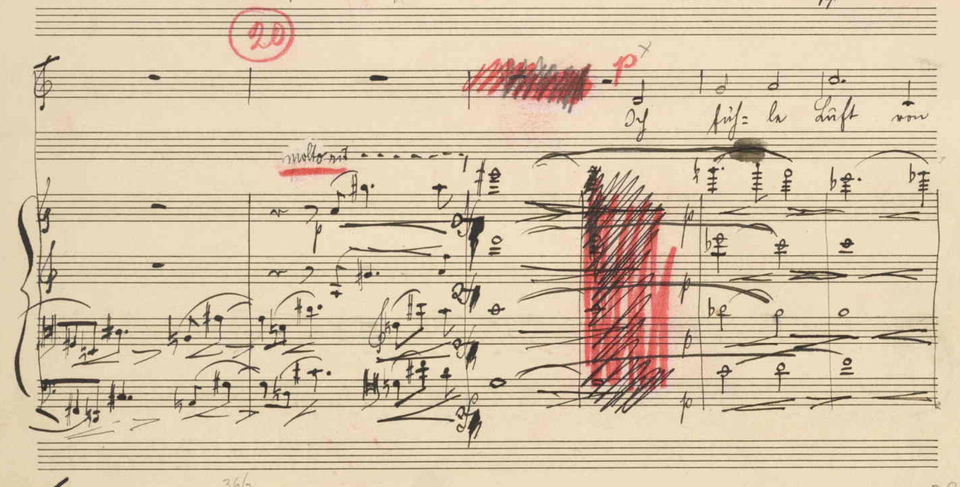
The final work I caught, on Thursday evening, was Arnold Schoenberg’s second string quartet, from 1908. In the composer’s output, the second quartet is a transitional work, moving away from the turgid tonality of his early years without yet being at the twelve-tone rigor he’s most famous for. Instead, the work stages the process of tonal dissolution in miniature: The first movement opens in a clear, if chromatically extended, F# minor. The second pummels its nominal D minor nearly to oblivion, but its frenetic momentum and drunken interludes help the harmonic chaos go down easy. The third takes a bruised Eb minor through a series of dissonant variations in a setting of Stefan George’s “Litanei” | “Litany” — which is sung by a soprano, who is also part of the final movement. That last movement begins with the barest wisps of tenuous sonic gas, shorn of any clear tonal center. Entering into this haze, the soprano rises across nearly an octave in stately half notes to begin George’s “Entrückung” | “Rapture”: Ich fühle luft von anderem planeten. | “I feel air from another planet.”
It’s one of the most shiver-inducing moments in all of classical music, subject and substance becoming one as a dizzying new world emerges ponderously into view. Its ecstasy is indistinguishable from terror. Wimbish returned for this work, full of impeccable Expressionist hauteur, and was joined by Calvin Alexander, Katherine Yoon, Gordon KH Lau, and Madelyn Kowalski. The quartet played with darkly burnished tone throughout, but they also captured the humor in Schoenberg’s music, a quality often overlooked in his output. The off-kilter scherzo had a genuine playfulness in their hands that made the frenzied turns all the more powerful since they had such contrasting music to play off of. Even in its bleakest moments, it was sinuously, undeniably alive.
The quartet ends, against all odds, with an actual F# major triad, just as Mozart might have written. But its emergence from the dissonant churn is decidedly eerie, and at the end of the movement it concludes, it sounds just as alien as everything that has just been heard. Even today, it is hard to come to terms with fully. A century and a quarter ago, a door opened in the classical music tradition; we’re still trying to figure out what’s on the other side.
A setting of the same Joseph von Eichendorff poem set by Robert Schumann in his Liederkreis. ↩︎
By Daniel Meszaros, clarinet; Christian Whitacre, bassoon; Stephen Stirling, horn; KJ McDonald and Alix Vaillot-Szwarc, violins; Lise Guérin, viola; Bea Magdalena Sallaberger, cello; and Noah Daniel, bass. ↩︎
Alice Van Leuven, Laura Morales Rejas, Natalie Clarke, and Olivia Cho. ↩︎
Ying Xue, Alix Vaillot-Szwarc, Jonathan Brown, and Alejandro Gomez Pareja comprised the quartet, with Nikki Pet joining for the Feldman only. ↩︎
Eduardo Leandro, Matt Boyle, Candy Guoer Pang, and David Wang ↩︎
In Brief
When not gallivanting across state lines, I’ve been idly trying to catch up on some of the things that I had to miss from the LOUD Weekend. Most recently, that’s meant albums by the guitarist and composer Yasmin Williams. Most of what I’ve heard is rather more laid-back than my typical fare, but you know what? It’s an awfully intense time right now and it’s pleasant, every now and again, to turn towards gentleness. Don’t mistake easygoingness for lack of depth.
The definitive recording of The Art of the Fugue for me will always be that of Trio 335 on oboe, bassoon, and accordion. Hearing this album for the first time was one of my deepest formative experiences; it’s how I fell in love with the music of Bach. I have no idea if it’s still available to purchase anywhere — I can’t imagine the initial print run was all that large — but happily, you can listen to the entire thing on YouTube. Their brisk tempos keep the entire affair moving gracefully along, though if you spend too much time with them, you may, like me, start to find everyone else’s takes on these fugues a too-slow slog.
This is obviously not really in the ambit of this newsletter, but it is firmly in the ethos of citing all my sources, so: The riff on Feldman, cathedrals, and expanses of time in the above review draws very much on Abraham Joshua Heschel’s famous exposition of the Sabbath. If you’re at all into Jewish religious philosophy and aren’t already familiar with it, check it out posthaste — its 144 short pages go extremely hard.
In My Calendar
As ever, these listings aren’t comprehensive, they’re just the ones that happen to have caught my eye and that I have particular interest in. If you’re a local artist, publicist, or presenting institution, please add me to your mailing list so I can keep up to date on what you have going on!
Events marked with a Ø are free and open to the public.
- August 13, 8:00pm: Iconoclastic icon Laurie Anderson comes to Tanglewood for a performance that includes a world premiere of one of her new works. Per the website, What War Is This? celebrates the anniversary of the Declaration of Independence; it is perhaps especially worth pondering now that document’s litany of every act which may define a tyrant.
- August 14–16, various times: The Marlboro Festival wraps up for the summer with three last concerts. Saturday and Sunday are already sold out, but Friday’s show, which includes Heitor Villa-Lobos’s wind trio, still has tickets available at time of writing. If you are one of the lucky ones with tickets to the final show, you’ll have the chance to see Janáček’s rousing Mládí and Britten’s rare second string quartet alongside the traditional closer, Beethoven’s choral fantasia.
- Ø August 16, 10:00am: Sunday morning chamber music continues at Tanglewood, including a world premiere by my old college roommate, Baldwin Giang. You could spin the rest of the program as a variation on the “three B’s”, with TMC Fellow Diallo Banks replacing JS Bach.
- August 16, 3:00pm: Music Mountain’s clarinet quintet series continues with a concert that pairs new works and arrangements with standbys from Mozart and Schumann. The third part of the series follows in a few weeks, but each concert should be satisfying in its own regard.
- August 16, 8:00pm: Laurie Anderson continues her time at Tanglewood with The Republic of Love, an evening that remixes some of her famous works while bringing in various other artistic voices in different capacities. Big Science meets Sexmob and Gertrude Stein!
- August 22, 8:00pm: Antonin Dvořák’s ninth symphony gets all the airtime, which is a shame, because his other symphonies are solid works, well worth hearing. His eighth gets some love this Saturday along with Bernstein’s Chichester Psalms and Price’s second violin concerto.
- August 23, 3:00pm: Music Mountain takes a week off from the clarinet to focus on piano trios instead, including an offering from Jennifer Higdon and an arrangement of Schoenberg’s brooding Verklärte Nacht.
Member discussion