Love in the Making
In Review: Culomba Opens PolyphonyFest at Bombyx
A confession: The pandemic tremendously enriched my Jewish practice. I was already in the habit of hopping around local synagogues to sample their offerings, but with congregations everywhere exploring online options in the devastating spring of 2020, I delighted in shul-shopping all across the continent. But I soon found this draining: One of the joys of praying with others is communal singing, raising my voice in an ocean of other voices and mingling in real time with the sonic tide. I could never tap into that simultaneity on Zoom, and paradoxically felt less lonely shutting off my computer and davening all by myself.
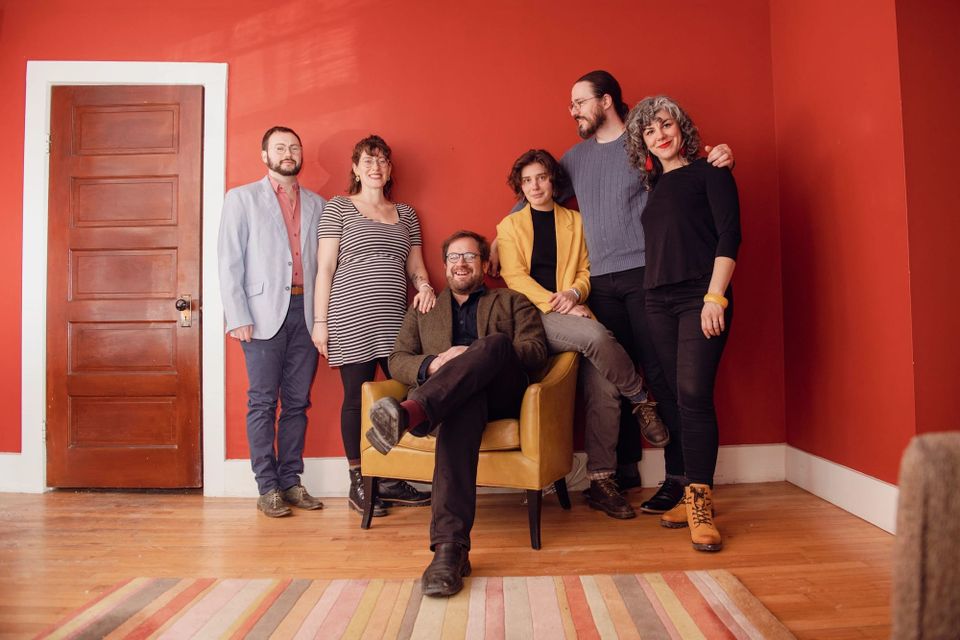
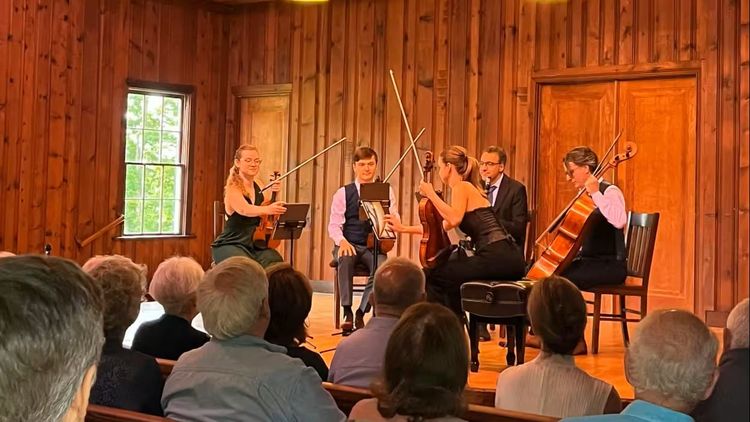
The joyous communal exuberance I so missed was on full display this past Thursday at Bombyx when Culomba opened their PolyphonyFest programming with an evening of close-harmony songs spanning continents and centuries. Pairing radiant bonhomie with immaculate technique, the vocal sextet teased out surprising resonances between wildly disparate repertoires without flattening the distinctions between them.
Close harmony is one of those maddening terms that’s at once technical and vague — fundamentally, it refers to a genre-agnostic harmonic technique of keeping all the notes sung at a given time within a relatively small range, but it often expands to denote the melodies that lend themselves to that kind of harmony and the bright, forward vocal color associated with the musical practices where the style abounds. When all these elements come together, the result is potent, focused, and intoxicating.
And come together they did in Thursday evening’s outstanding first half. Culomba has a preternatural ability to blend their voices — even with great effort, I struggled to tell exactly who was singing which note. Many of the Eastern European numbers on the first half featured asymmetrical meters and jagged rhythmic stutters; with Culomba’s hive-mind synchronicity, their Bulgarian medley took on the improvisatory freedom of a single individual while the pungent harmonies rang out with the pleasurable intensity of a recent bruise. “Feathered Dove”, a Sacred Harp number by Culomba member Adam Simon, ached with tenderness and abiding faith.
Things flagged after the intermission. A series of slow numbers — including an exquisite rendition of the delicate “Flos Florum” by French Renaissance composer Guillaume DuFay — provided a welcome respite at first, but soon became a bit of a snooze; an oddly listsless rendition of “Deep River” led into a baffling re-setting of the text of “Amazing Grace” without any reference to the iconic standard tune. But a final Bulgarian medley picked things back up, including an impromptu dance line snaking its way around the hall.
That participatory spirit was elsewhere in evidence. Later PolyphonyFest events included workshops to learn this style of singing and a final concert performed by expert and amateur alike. Their merch table included a songbook complete with helpful audio tracks — if you’ve ever wanted to sing music from the Flemish fifteenth century, this is your chance. The motivation behind the invitation was simple and direct: “There’s no better way to love this music than to make it”, ensemble co-founder Sophie Michaux explained from the stage. Even in the simplest moments, that love radiated out into the room, palpable, wondrous, alive.
In Rotation
I’m (perhaps notoriously) slow to listen to albums, but one of the nice things about recorded music is that it doesn’t go bad — if you don’t catch a new album on the very day of its release, you can still check it out months, even years, later. And, frankly, the older I get the more annoyed I find myself with the tendency to treat new releases with blink-and-you’ll-miss-it urgency. Even if it’s been some time, a good release is still worth celebrating. So, in that spirit, here are a few not-so-recent releases I’ve been spending time with as the trees outside my window turn to brilliant orange.
I hardly need to hype up Yanga, a compilation of orchestral works by Gabriela Ortiz, which won three Grammy awards earlier this year. But the thing is: Sometimes, celebrated things are, in fact, very good; Yanga is the first album in a long time I’ve listened to and then immediately played over again the moment it finished. The orchestral writing is vivid and captivating in its own right, but I also found myself struck by Ortiz’s relationship to broader musical trends. She draws from Latin American dance music, but there are also echoes of high minimalist shimmy and shimmer. Given African drumming’s influence on both the minimalist movement and the music of Latin America, this confluence feels almost like a homecoming, a transformed echo returning to a transformed iteration of the source.
For a very different approach to some not wholly dissimilar musical materials, follow that up with this collection of Tania León’s orchestral works. Angular and astringent, some may find these pieces are harder to get into than those collected on the album above, but they’re abundantly worth the effort.
Finally, I was so pleasantly surprised by Fredrick Ullén’s complete set of Transcendental Etudes by the reclusive midcentury composer Kaikhosru Shapurji Sorabji. Prior to this, I was most familiar with Sorabji’s gargantuan solo piano works — individual suites and sonatas for solo piano that take as much as six hours to perform with ferociously virtuosic writing. The virtuosity is, unsurprisingly, fully in evidence in the Transcendental Etudes, but the proportions are much more human. A few sprawl out to great length, but most clock in at a few minutes, and some don’t even make it to a full sixty seconds. What’s more, Sorabji takes a break from his usual esoteric fury to pen etudes that are, by turns, diaphanous, breezy, and even wryly humorous. The sequence of three starting with the seventy ninth are especially compelling, if you’re looking for a place to dip your toe in. A tremendous achievement!
In My Calendar
As ever, these listings aren’t comprehensive, they’re just the ones that happen to have caught my eye and that I have particular interest in. If you’re a local artist, publicist, or presenting institution, please add me to your mailing list so I can keep up to date on what you have going on!
Events marked with a Ø are free and open to the public.
- Ø Oct 20, 7:30pm: A whole bevy of trombones descends on UMass[1] for an evening of music ranging from Hayden to contemporary Jazz. Variety is the spice of trombone, or however the saying goes...
- Oct 22, 7:00pm: Up in Vermont, Marlboro Music comes to the Brattleboro Music Center with a program that includes works by Kaija Saariaho and Brett Dean alongside more typical concert fare. A rare chance to know what’s going to be on a Marlboro program before buying tickets to the date in question.
- Oct 23, 7:00pm: Accordion virtuoso Radu Rățoi comes to Tanglewood for a program that includes a whole potpourri of classics, transcriptions, and more contemporary fare. How does an accordion play a violin concerto? I’m not entirely sure, but it could be fun to find out!
- Oct 23, 7:30pm: Closer to home, the UMass symphony orchestra gives the world premiere of a new concerto by my friend Annika Socolofsky. Shostakovich’s high-octane fifth symphony rounds out the bill.
- Oct 23–25, various times: Speaking of Gabriela Ortiz, there’s a chance to hear her Kauyumari at the Hartford Symphony Orchestra. If you scroll down to the bottom of the page, it looks like tickets include a pre-concert talk, which hopefully won’t be all about the Chaikovskii...
- Oct 24, 7:30pm: The Springfield Symphony Orchestra continues their year-long search process for a new artistic director with a concert pairing a new work with an old chestnut. Artistic director searches can sometimes push people to program conservatively, so it’s nice to see that at least some of the candidates are keeping the new work coming.
- Ø Oct 27, 11:00am: Embrace the spooky season with this topical free concert from UMass, assuming you can get away in the middle of the day. My money is on the piece called Landscape of Fear being a bit more unsettling than whatever Brahms they’re trotting out, but perhaps I’ll be mistaken on that front!
- Ø Nov 1, 4:00pm: Come back to UMass a few days later, and you'll have a chance to hear a percussion concert on the university’s Percussion Day. No repertoire posted yet, but percussion concerts reliably skew towards the new.
As ever, I am employed full time by UMass, but not in any capacity related to their preforming arts programming. ↩︎
Member discussion