Stage Directions
A quick scheduling note: The next issue would ordinarily go out on September 21, which this year happens to be Yom Kipur. Needless to say, I’ll be otherwise occupied that day, so after the regularly scheduled essay for $10+ members on the 16th, the next free issue will go out on Monday, October 5. In the meantime, I wish you and yours a sweet start to the new Jewish year. May the coming months bring you nothing but good things, and may we all find ways to make the world a little kinder and more just.
In Review: Clarinet Quintets at Music Mountain
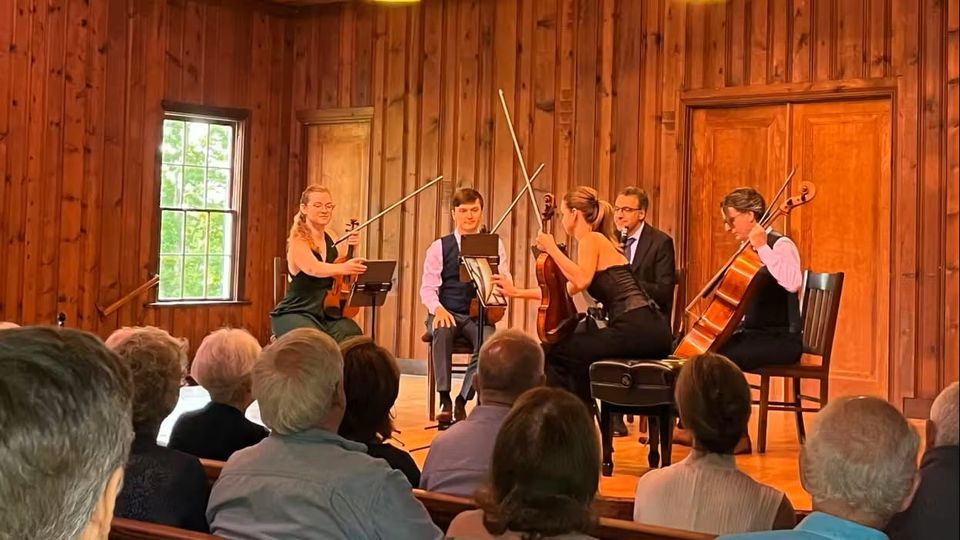
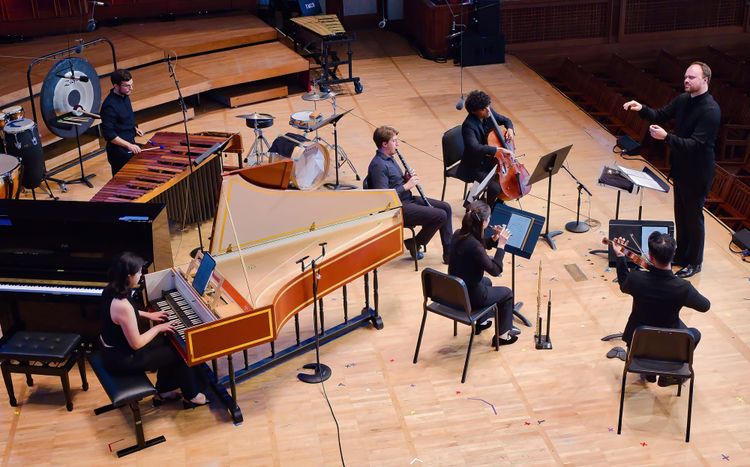
Artistic Directors at symphony orchestras may spend much of their time making music in front of an audience, but chamber music festivals are a different beast. While assembling performances from a rotating cast of small ensembles, the leaders of chamber series often don’t spend much time in the limelight themselves. How refreshing, then, to see Music Mountain’s Artistic Director, Oskar Espina Ruiz, celebrate ten years in the role by playing a series of concerts that included multiple world premieres of works written specifically for him. At a time when musical institutions across the country are facing critical breakdowns between artists and management, this Connecticut festival presents a joyously freewheeling atmosphere where administrators become performers, performers become composers, and no part of the musical ecosystem is cut off to fend for itself.
Across three weekends in August, Ruiz, on clarinet, joined three visiting string quartets for programs running the entire gamut of the clarinet quintet repertoire. (I caught the second and third installments, with the Ulysses and Cassatt quartets, respectively.) In keeping with the festival’s general ethos, each program also featured the string quartet alone and with other guests in assorted warhorses of the standard repertoire and lesser-known gems.
Any suspicion that this series was an exercise in ego fluffing was swept aside immediately at the start of the first show I saw, which opened with the premiere of the revised version of Seth Grosshandler’s suite for clarinet quintet. Espina Ruiz is a magnificent clarinetist, effortlessly burbling through gnarly runs while sweeping from the cusp of silence to thunderous peals without ever losing the immaculate polish of his tone. Beyond this technical finesse, he imbued even slight gestures with a compelling depth of feeling. Grosshandler’s is a warm-hearted, easygoing work, simple without ever being simplistic, and Espina Ruiz and the Ulysses players presented it with a truly charming playfulness.
The quartet brought other colors to the fore in Mozart’s K 171 quartet (1773) and Robert Schumann’s 1842 piano quintet, both in E flat. The opening of the Mozart was arrestingly muscular and thick, a hearty sound you could chew on before the delicate briskness of the following allegro. Joined by pianist Max Levinson, they kept a keen forward propulsion across the Schumann’s extended duration, right through the joyously bustling fugue that brings the work to its ebullient close.
Even so, the high point of this first concert came just before intermission, with a set of four arrangements, one by each member of the quartet, of folk tunes from their respective heritages. The arrangements ranged from fairly direct transcriptions to allusive fantasias, but each was played with profound affection by the group; every movement was a gift from one member to the others.
Folk tunes played a role on the Cassatt Quartet’s program, too. The group opened with two of Florence Price’s Folk Songs in Counterpoint (1951), “Clementine” and “Shortnin’ Bread”. I found the first a little disjointed, but as the concert went on, this turned out to be a pattern: In several works, the Cassatt players started on the wrong foot, taking several minutes to settle in to their performance. Once settled, they played at a high level, but several opening movements were rough. In the Mozart viola quintet (K 516 in g, from 1787) that followed, the first movement remained unsettled until nearly the end of the exposition, but the second achieved a rarefied elegance, and the finale launched with taut, relentless power.
The Cassatt players were joined by longtime Cuarteto Latinoamericano violist Javier Montiel for the quintet, and Montiel also featured as a composer, having written Mountain Wind for Espino Ruiz to premiere that afternoon. Here, at least, the first movement shone: Cast in the form of an introduction and dance, the piece begins with a long, slow inflation, hazy chords rising out of the ensemble with pizzicato bell tones like a hot air balloon slowly filling with air on the ground — lopsidedly monstrous at first as it gradually heaves upwards into balanced majesty. The ensuing dance was less compelling. Although filled with plenty of whirligig escapades, a glut of slower interludes sapped its forward momentum.
No such problems affected the concert’s finale, Carl Maria von Weber’s clarinet quintet from 1815. One of the great galumphing showpieces that the nineteenth century produced in such abundance, it’s a work that makes up in virtuosity what it lacks in depth. Perhaps its most arresting musical feature is a little syncopated gesture that recurs throughout the minuet and sounds uncannily like a premonition of a Joplin rag, but even when reaching for profundity in the second movement, the piece sounds like it wants to play at the circus.
But here’s the thing: I’m not too good for a bear on a unicycle. Listening to Espina Ruiz arpeggiate eelily all over his instrument while the strings stampeded towards the final bar, the affair passed the only test that really matters — the whole thing was tremendous fun. Life cannot be lived solely in solemnity. Even in dire times, sometimes you have to get a little silly with it. Bring on the clapping seals!
In Brief:
One of the great joys of returning to Western Massachusetts has been getting to know the UMass bassoon professor, Rémy Taghavi.[1] With pianist Steven Beck, he has a new album out, Mizansen, which features works written by French and Iranian composers — if you had the pleasure of catching his faculty recital in February, many of the offerings will be familiar! Personal and professional closeness preclude me from offering a formal review, but even if our paths had never crossed, I still think I would find the album well worth a listen.
As ever, UMass Amherst is my full-time employer, though I do not work in any capacity related to their concert offerings. ↩︎
In My Calendar:
Summer may be ending, but local music isn’t! As the students return, so do campus concerts, and many other offerings besides. As ever, these listings aren’t comprehensive, they’re just the ones that happen to have caught my eye and that I have particular interest in. If you’re a local artist, publicist, or presenting institution, please add me to your mailing list so I can keep up to date on what you have going on!
Events marked with a Ø are free and open to the public.
- Ø Sept 11–13, various times: The Five College New Music Festival returns for a series of free concerts under the banner of “Music without Royalties”. All of these shows take place during Rosh haShanah this year, so devastatingly I will be unable to attend, but please understand how much I want to be there in spirit. The full lineup includes:
- Sept 11, 7:30pm: A program of mostly local composers, including a world premiere by local opera maven Eric Sawyer.
- Sept 12, 2:00pm: Festival coordinator Elizabeth Chen and friends play a set of violin duets (and one trio) by a slate of composers who are mostly unknown to me.
- Sept 12, 7:30pm: The festival dives into the high modernist deep end with works by Carter, Kurtág, Walker, Feldman, and more. Expect to have your ears scoured, but also, perhaps, ethereally consoled.
- Sept 13, 3:00pm: Things come to a close with a program that presents music by inveterate trans tinkerer Sarah Hennies next to Luciano Berio’s luminously unsettling “O King”
- Sept 13, 4:00pm: No word that I can see on the repertoire for this cello/piano concert at The Drake, but in the past, their curation has been thoughtful and full of interesting surprises, so potentially well worth checking out.
- Ø Sept 13, 7:30pm: Back at UMass, the fall faculty recital calendar kicks off with a joint trumpet/trombone/piano performance that promises a wide-ranging sonic landscape. Come for Enescu’s Romanian folk Romanticism, stay for Lynn’s Brief Torture for Unaccompanied Trombone.
- Sept 19, 7:30pm: Out at the woman-centric Institute for Musical Arts, Isle of Klezbos performs an evening of klezmer music. I don’t know the group specifically, but you sure can’t beat the name!
- Ø Sept 21, 7:30pm: Not content to show off only their own faculty, UMass presents artists from one state over as the Ithaca Winds breeze through town. From the listed artists, I suspect the program will lean towards the high-energy side, so if you’re looking for the exact opposite to Yom Kipur, this might just be it.
- Ø Sept 23, 7:00pm: Oboist Aaron Lakota presents a high-concept, multi-genre chamber program at The Drake. How often do you get the chance to hear jazz oboe?
- Ø Sept 24, 11:00am: Theorist Doug Abrams gives a public lecture on form in the scherzo of Bartók’s fifth string quartet. It’s possible this will get quite heady, but it also seems like a great opportunity to hear some cutting-edge research on new ways to think about music directly from the horse’s mouth.
- Sept 26, 7:00pm: Up in Brattleboro, the Juventas New Music Ensemble presents an evening of new works including a world premiere by Oliver Caplan and a piano trio by the ever evocative Reena Esmail.
- Sept 26, 8:00pm: That same evening, Andris Nelsons leads the Boston Symphony Orchestra in a posthumous premiere by Gubaidulina alongside Mahler’s titanic seventh symphony. (The same program is also being given on Thursday evening and Friday afternoon.) Obviously Boston isn’t exactly Western Massachusetts, but this is the last new work by Gubaidulina we’ll ever get, and also the best of Mahler’s eleven symphonies,[1], so it seems worth calling attention to.
- Oct 2–4, various times: The Hartford Symphony Orchestra doubles up on brass concerti, pairing Strauss’s first horn concerto with a recent work by young British composer Dani Howard for trombone. Dvořák’s ever-popular ninth rounds out the bill.
- Ø Oct 2, 7:30pm: Over at Williams College, the Berkshire Symphony pairs Mussorgsky’s Pictures at an Exhibition with one piece by Nico Muhly and another by Barber. I will be busy shaking a lemon at G-d as the new year holidays draw to their close, but perhaps some of you will be able to make it!
- Oct 3, 2:00pm: The Pioneer Valley Symphony kicks off their 88th season with a program that includes Leoš Janáček’s delightfully peculiar Sinfonietta.
- Oct 3, 7:00pm: That same evening, the Brattleboro Music Center presents A Passion for the Planet by Geoffrey Hudson. In a nice gesture that echoes our hopes to leave them a livable world, kids under 12 get in free.
Phew, OK! Hopefully that’s enough to tide you over until next time. I’ll see you back here again on the fifth!
In this house, we count Das Lied von der Erde and the tenth. ↩︎
Thank you for reading That Supreme Alive-ness! Your support is what makes this kind of independent local music journalism possible. If you like what you read and haven’t done so already, consider upgrading to a paid membership to unlock bonus essays at higher tiers. And if you really like it, consider sharing this newsletter with a friend! Word of mouth remains the best publicity there is.
Member discussion