Greening
NB: In order to provide full coverage of Tanglewood’s Festival of Contemporary Music (see below!), the next issue of this newsletter will be published on Tuesday, July 28, instead of July 27. Stay cool in the meantime!
In Review: Contemporary Chamber Music at the Tanglewood Music Center
If you take a magnifying glass to a clump of moss in the forest, an entire world will unfold before your eyes. There will be the little spiky leaflets of the moss itself, of course, but also often capsules of spores, lichenous scabs, even contrasting leaflets of some competing bryophyte. What’s easy to dismiss as a homogeneous green backdrop turns out to contain enough textured variety to enrapture the curious eye for hours.
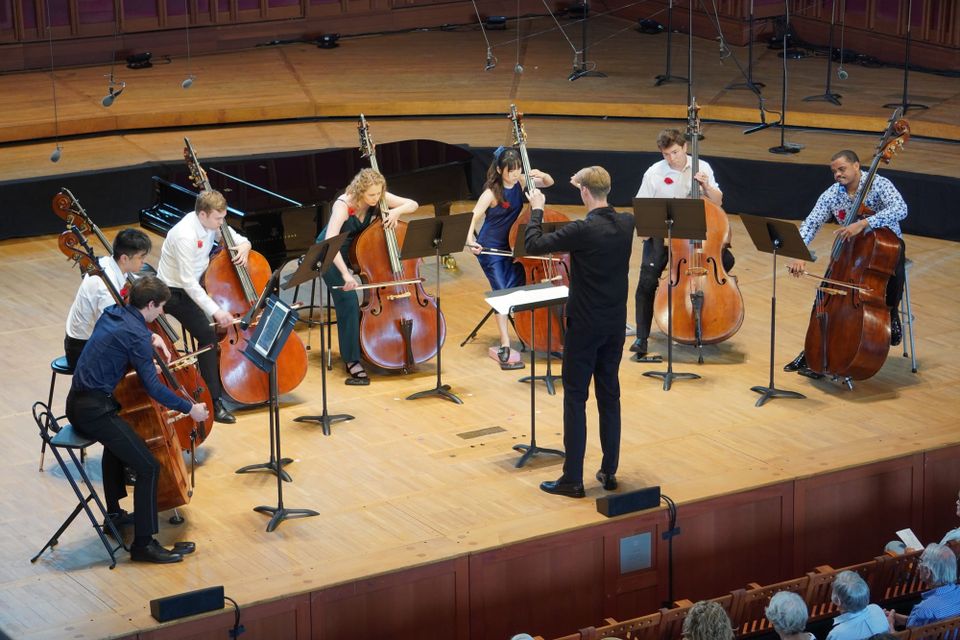
That botanical microcosmos flourished in my mind as I listened to Liann J Kang’s Viriditas in its world premiere performance by Tanglewood Music Center fellows on Sunday, July 5th, at Tanglewood’s Seiji Ozawa Hall. Scored for seven double basses,[1] the work unfolds in languorous, thrumming ease, the ensemble members passing around upper-register tremolos and shimmering glissandi between powerful rumblings from the acoustic depths and skittering pizzicato gestures. Although the instrumental parts are numbered one to seven, the music is thoroughly egalitarian, a colloquy of equals on a breezy summer afternoon.
Viriditas opened the second half, but the morning’s musical heart came earlier, in a back-to-back pairing of Elliott Carter’s Eight Etudes and a Fantasy for wind quartet (1950) and The Faculty of Sensing for wind quintet (2024) by George Lewis. Both works push their players[2] to virtuosic extremes, and both are dense with rhythmic complexities, pointillistic textures, and dissonant harmonic snarls, but these surface similarities work towards different ends. The Carter is all high-modernist coolness, an immaculate surface of musical abstraction. The TMC quartet brought an impeccable blend and effortlessly fluid technique to it, but sometimes struggled to give convincing structural shape to movements as a whole. The Lewis, on the other hand, is deliberately evocative: One of a series of Lewis’s works in dialogue with the Afro-German philosopher Anton Wilhelm Amo, The Faculty of Sensing unleashes shrieks, falls, and crumpled-up harmonies as an explicit metaphor for human life as a set of unstable, ever-moving relationships. That’s all very heady, but Sensing is also funny: players schlorp on their reeds to make kissing noises with their instruments, and more than a few licks come across as sarcastic eyerolls — get a load of this! — towards the music that came just before.
These two works’ ferocious detail suffused the rest of the concert, teasing out resonances that otherwise may not have been apparent. Even the three Gabrieli works at the end[3] took on this tinge — the burbling trumpet roulades of the Canzon per Sonar Duodecimi Toni (1597) seemed like long-lost kin to Carter’s quicksilver second etude, and the massed chords of the Canzona per Sonare No 2 (1608) presaged the shattering weight of Lewis’s quintet.
Earlier, Joseph (Sehyeok) Park’s second quartet (2025), for clarinet, violin, cello, and piano[4], resonated with both works. The elegiac opening movement evolved gradually from a desolate, fragmented landscape, brutally indifferent as an Antarctic winter, to a delicate, hard-won warmth, as ghostly as it was consoling. The mercurial second movement then fought to keep that warmth in the face of a breathless moto perpetuo threatening to whirl everything apart.[5] To my ear, the piece could use one more round of light edits, especially the first movement, which lingered one beat too long; even so, it’s an assured work, deftly built.
The morning opened with Mark-Anthony Turnage’s New England Etudes (2022) for a percussion sextet[6] playing everything from gongs to handbells. The etudes themselves are similarly wide-ranging, from the softly luminous chords of the static second to the bebop toccata of the sixth. The strongest, after which I wanted nothing more, was the fifth, “Bells for Ukraine”. True to its name, it’s the only movement to feature handbells, which ring out a plainspoken chorale melody devastating in its simplicity. Without mimicking the violence of war, it opened a holy space for holding the grief of Ukraine’s devastation. In the warmth of Tanglewood’s green, I was still, and I wept.
Correction, 2026-07-30: An eairler version of this article misspelled Liann Kang’s name.
For this performance: Dennis McIntyre, Eugene Zhang, Kevin Fink, Alexis Schulte-Albert, Yu-Hsuan Huang, Nicholas Boettcher, and Christian Harvey, conducted by Julian Gilewski. ↩︎
For the Carter: Claire Kim, flute; Izaiah Cheeran, oboe; Henry Lazzaro, clarinet; and Dylan Neff, bassoon. For the Lewis: Ellen Hayun Lee, flute; Jeehoon Kim, oboe; Chin-I Lee, clarinet; Christine Ott, horn, who carried off a part that often felt more like a concerto solo than a chamber music member with aplomb; and Alexander Lake, bassoon. ↩︎
Performed here by the TMC Brass Ensemble conducted with effusive warmth by Lauren Smith. ↩︎
Eric Butler, Sheena Lan, Han Lee, and Jessica Yuma, respectively. ↩︎
I suspect sonata form is lurking in the background here, though having only heard it once and not having a score to consult, I wouldn’t swear to it absolutely. ↩︎
Here Patrick Sorah, Liam McManus, Gustavo Barreda, Dillon Akerman, Harry Yihao Zhang, and Parker Meek. ↩︎
In Brief
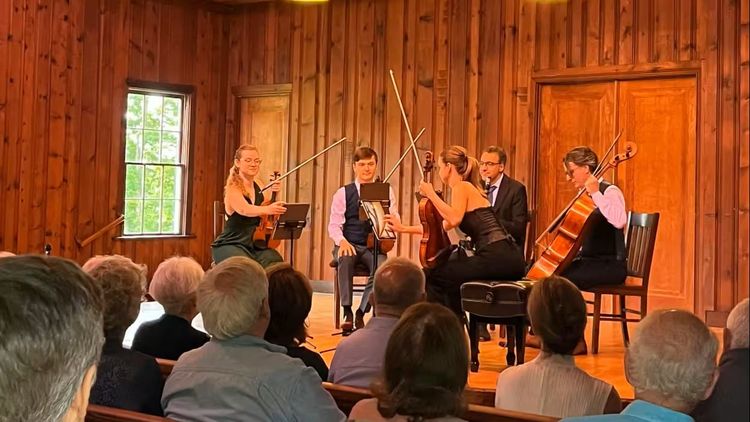
If you’ve often felt tired and sad of late, you’re in good company — both in the present and in the past. That was the premise of Monadnock Music’s Weary Blues concert, which I caught yesterday at Congregation Ahavas Achim in Keene, NH. Comprising pieces written for some combination of cello, baritone voice, and piano,[1] the program featured works of sorrow and world-weariness including Samuel Barber’s impassioned cello sonata (1932) and Sonja Béets’s phantasmagorical setting of a poem by Willem de Mérode, Melancholia (1999). Some of these pairings were a little rough: The narrator of Robert Schumann’s “Stirb, Lieb’ und Freud” | “Perish, Love and Joy” (1840, text by Justinus Kerner) tells a classic tale of Romantic woe — I have a crush on a girl but never told her or tried to act on it in any way; now she’s becoming a nun and I’m sad — but coming directly after Dorothy Rudd Moore’s setting of Langston Hughes’s “Weary Blues” (1972) — a crushing portrait of the psychic toll of systemic racism in America — it’s hard not to want to tell that young fellow to just get over himself.
That feels harsh and ungenerous — surely every heart is entitled to its own sorrow, and feelings are rigorously immune to any kind of logic — but the direct juxtaposition makes it a hard sentiment to escape. Walter Rabl’s “Soldatentod” | “A Soldier’s Death” (1899, text by Mathilde Grassberger) fared better: In the midst of much similar moping, the dead soldier laments “Was kümmert’s mich ob dein, ob sein dies Land mag zugehören?” | “What do I care whether this piece of land belongs to you[, my Fatherland,] or to someone else?”. A radical statement in Rabl’s era of nationalist saber-rattling, and tragically no less so in ours.
Rafael Popper-Keizer, Aaron Engebreth, and Yoko Hagino, respectively. All three turned in respectable performances, though Engebreth’s upper register grew a little pinched at times, especially compared to his resonant middle. ↩︎
In My Calendar
This set of listings is not comprehensive; it’s just what happens to be on my radar that I’m particularly excited about. If you are a performer, presenter, or publicist in the local classical music scene, please add me to your mailing list so I can keep an eye out for your offerings!
Entries marked with a ∅ are free and do not require advance registration.
- Ø Ongoing: The 2026 Etchings Festival has just wrapped up, but the sound walk they created for Northampton’s Look Park is still available for exploration at your leisure. Given the recent temperatures, I’m loathe to venture outdoors any more than I have to currently, but if you’re hardier than I, bring your phone and some earbuds to the park one day and take a sonically guided stroll.
- July 17, 8:00pm: Operatic superstar Renée Flemming visits Tanglewood in a concert that features selections from Nixon in China alongside Samuel Barber’s lyrical, iconic violin concerto and a newer work by the BSO’s Composer Chair, Carlos Simon.
- July 18, 8:00pm: The Marlboro Music Festival kicks off with a program pairing staples of the repertoire by Haydn and Mozart with a work for horn and string quartet by Philip Maneval. As of this writing, there are a few tickets left, but they’re going fast, so don’t hesitate if you want to attend!
- July 19, 2:30pm: Speaking of going fast, this first Sunday concert at Marlboro is already sold out, but if you’re one of the lucky folks who has tickets already, you’re in for a treat with Sofia Gubaidulina’s sonata for double bass and piano among other offerings.
- July 19, 3:00pm: The Music Mountain Summer Festival brings in the Daedalus Quartet for a program that offers a chance to hear some out-of-the-way works by Amy Beach and Germaine Tailleferre alongside a piece by Andrew Davis and one of the classic late Beethoven quartets. I’ve long felt that the classical music world wrote Tailleferre off much more quickly and harshly than she deserved, so I’m glad to see her getting some airtime here!
- July 22, 8:00pm: I cannot go to this performance of the complete Philip Glass etudes for solo piano because of the fast of Tisha bə’Av, which is devastating because they have quite the lineup of performers slated to bring these mesmerizing works to life. If you go, please tell me how it is!
- July 23–27, various times: The Tanglewood Festival of Contemporary Music! Far from the only chance to hear music of our time this summer, but a concentrated dose of newness all the same. This year, the concerts are:
- Ø July 23, 8:00pm: “Those We Have Lost Too Soon” features a lineup of memorial works by a handful of titans of the twentieth and early twenty-first centuries.
- Ø July 24, 2:30pm: “Meta Music”: They say all art comes from other art, and sometimes that’s very literal indeed. Odds that at least one program note mentions “intertextuality” are high, but as a huge fan of quotation and paraphrase, I’m not going to complain!
- Ø July 25, 6:00pm: “The Next Generation” presents some newer voices on the scene, most of which are delightfully unfamiliar to me.
- Ø July 26, 10:00am: It feels a little odd to call anything by Ligeti or Lutosławski an “old chestnut”, but next to the hot-off-the-press-works on this morning concert, that’s effectively what they are. I know nothing about Delfin Demiray’s as an antidote to fear of death, i eat the stars or Maya Miro Johnson’s bruises (disambiguation) except that the titles are phenomenal — I hope the pieces live up to them!
- July 27, 8:00pm: I don’t know whether the title “Nordic Boomers” is meant to refer to the generation of the composers in question or just the fact that these pieces are going to be big and loud, but either way, that’s what they’re calling this climactic concert in the series.
- July 25–26, various times: There are still tickets available to the second Saturday of the Marlboro Music Festival, but the Sunday show is already sold out, a good reminder to plan ahead if you’d like to get up there this summer. The repertoire for both concerts will be announced this Friday.
Member discussion