Of Cardinals and Coups
In Review: MIFA/Victory Players: The Golden Age
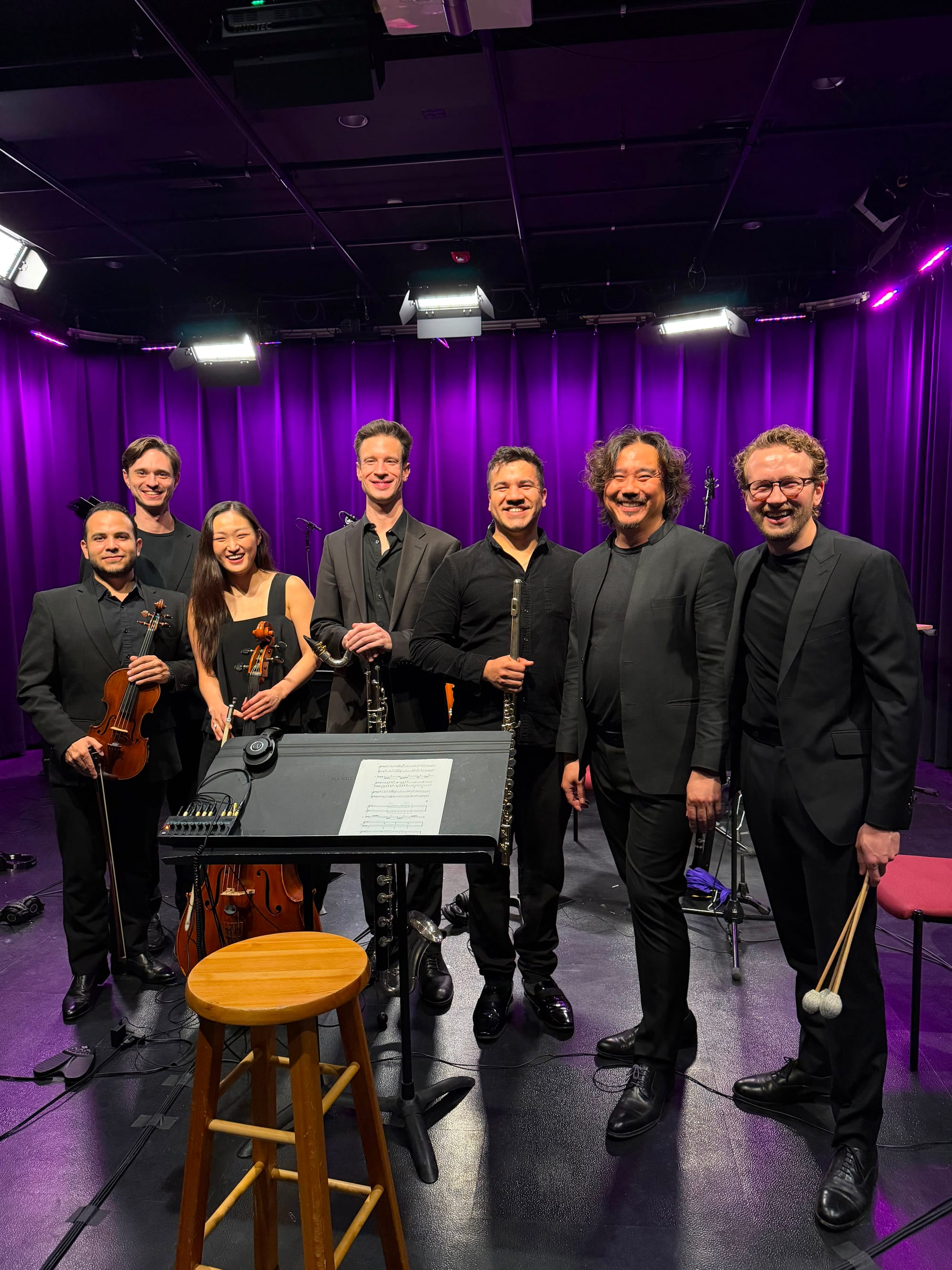
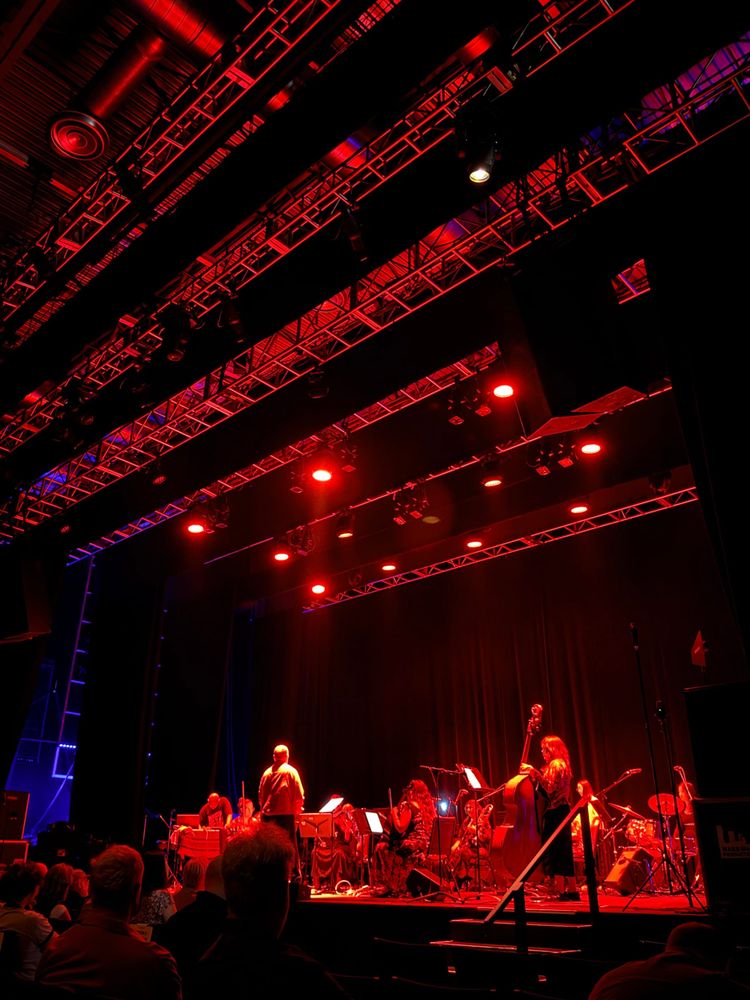
It’s not every day someone cites Ringu’s Sadako as an inspirational figure. But that’s just how Emily Koh introduced her new work unbound, hailing the murderous ghost as a woman who “has a strong sense of identity and knows what she wants”. The piece, written for the Victory Players pierrot ensemble and premiered this past Thursday at the De La Luz Soundstage in Holyoke, uses the scratching sound of an overpressured violin bow to represent liberation from the bonds of patriarchal femininity, subverting conventional associations between freedom and beauty.
Koh’s work was one of five premieres that evening. The first was Felipe Salles’s 1964, a cautionary tale about political instability and the death of democracy. In the work, Salles takes a recording of a speech by Jânio Quadros — the Brazilian president whose 1961 resignation led to a military coup three years later — and slices it into short segments, some as slim as one syllable, deriving rhythms and melodies from the politician’s oratorical cadence. The result is twitchy and unsettled, ever anticipating catastrophe but unsure how to prevent it. Charles Shadle’s Dancing Rabbit approached catastrophe from the other end. Named after the creek that gave its name to the treaty that forced the Choctaw people’s expulsion along the Trail of Tears, the work uses skittering gestures and trudging lines to evoke a hollowed-out world whose surface pleasantness belies a history of violence.
The remaining works presented two other approaches to nature. Kiegan Ryan’s ᏙᏧᏩ | Totsuwa | Redbirds references the cardinal as an omen of change to celebrate increased Native representation in classical music. Lush and unabashedly Romantic, the work begins in homey quietude then takes a melancholic detour before a triumphant ending. David Ibbett’s Crab Nebula closed out the night with a hard-driving tour of the eponymous supernova remnant. If some of the shimmery electronics were a hair cheesy, it was hard to care when the performers were having such evident fun.
Between these works were excerpts from composers currently workshopping new pieces with the ensemble.[1] As these were drafts, it seems premature to offer public comment, but I must commend flutist Giovanni A Pérez for his virtuosic cadenzas. Still, if these augured accurately, next year’s show should be strong indeed.
Despite the evening’s celebratory energy, the present political moment hung heavy in the air as the music director, Tianhui Ng, and the composers discussed their works. Few offered concrete plans for thwarting fascism,[2] but Ryan’s remarks stuck with me nonetheless. He affirmed the importance of creation in the face of horrors. “We can always have joy;”, he insisted. “You can never take away our songs.”
In the interests of full disclosure, I have a professional friendship with the Victory Players clarinetist, Eric Schultz, and I submitted to their most recent call for scores, so there’s a distant possibility that one of my works could be included in one of their concerts circa 2028. ↩︎
Which, to be clear, is fine! A concert is not a political organizing committee or an activist think tank. ↩︎
In Review: Legoland
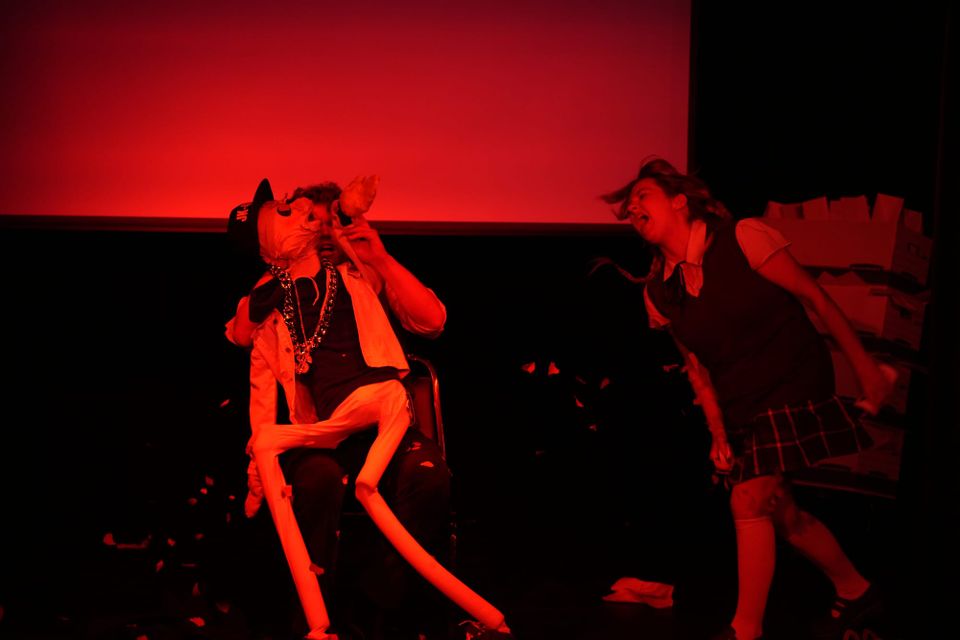
I’m not entirely sure that Legoland’s premise “makes sense”, but maybe that’s a good thing: If you’re not willing to roll with the wacky right from the jump, this isn’t the show for you. Written by Jacob Richmond, the play presents itself as sixteen-year-old Penny Lamb’s cautionary saga of how she and her thirteen-year-old brother, Ezra, got themselves arrested, recounted as part of her probation. Many gleeful absurdities follow: In the space of an hour, we go from a hippie pot farm to a teen heartthrob rent limb from limb by a frenzied mob to an international road trip funded by selling ADHD meds. The two siblings are the only two people on stage, but Ezra deploys a cavalcade of puppets to summon other characters to populate the world.
Needless to say, the humor is broad and the pace relentless. Not all the jokes land, and cheap stereotypes abound, but the sour notes don’t linger (indeed, nothing does) and another hijink is always swift to ensue. Legoland is not a show that’s interested in exploring the disorienting isolation of leaving a cult you were born into or the intersecting dynamics of white musicians adopting caricatures of Black masculinity to launch rap careers; it’s a show that’s interested in seeing how long it can maintain its manic rush from antic to antic to antic.
This frenetic pace demands tremendous stamina from the actors, and Julia Adamo and Terrance Fables — as Penny and Ezra under the direction of company founder Devin Dumas in the production by the Why’s It Gotta Be? Theater Group that ran for two weekends at CitySpace at the end of May — were up to the challenge. Each summoned more energy every five minutes than I manage in an entire month, blasted into the audience with million-watt enthusiasm. One minute they faked seizures for conversational sympathy, the next they danced leaping jigs, the next they flung confetti everywhere to mimic spurts of blood. In keeping with the ad-hoc setup, the sets and costumes are charmingly simple, but the crew gets good mileage from them — a pair of extra-stretchy undergarments allow the main antagonist puppet at one point to grow ominously taller and taller to tremendously unsettling effect.
Why’s It Gotta Be? bills itself as a home for queer theatre. Those attending this, their inaugural production, expecting a big same-sex love story or an exploration of gender expansiveness would have been disappointed. Lesbians are mentioned, but only as an insult bullies hurl at Penny in Catholic school. Under the surface, however, is a hint of promise for future shows with deeper scripts. For all of Legoland’s torrent of words, its most compelling feature was left unsaid: The production’s beating, buried heart is the way a chipper outward persona can mask a feral loneliness — the way desire, ignored and unfulfilled, can curdle into ravenous, destructive impulses beyond any human power to arrest.
In My Calendar: Summer Festival Edition
For this week’s listing section, I want to do something a little different: Summer festival season is almost upon us, and because that augurs many packed weeks in the coming months, I wanted to gather various festivals together here at a high level to provide at least a little framework for the oncoming rush. As ever, this is not an exhaustive list; if there’s something you think I’m missing — and especially if you’re an artist, presenter, or publicist in the area — please reach out and let me know about it!
- June 7–September 6: Over fifteen consecutive Sundays in northwestern Connecticut, the Music Mountain Summer Festival covers tremendous ground, including living composers on almost every single concert. I’m especially excited about their series exploring the possibilities of the clarinet + string quartet ensemble — it’s a chamber setup that has tremendous musical potential, and many composers other than Brahms have written great works for it.
- June 25–28: The New Directions Cello Festival comes to Smith College and Florence for a concentrated weekend of stylistically diverse music. Many summer festivals take a potpourri approach to programming; it’s an enticing prospect to be able to do a deep dive into the possibilities of one specific instrument.
- July 2–19: Down in Rhode Island, the Newport Classical Music Festival hits a lot of the standard repertoire, but there are some more unusual gems tucked away in its wealth of offerings. They have a thoughtfully programmed US 250 concert that explores one particular sliver of our musical history, a rollicking saxophone quartet, and an appearance from the ever-inventive Sandbox Percussion, among other enticing fare.
- July 7–30: More to the north, the New Hampshire Music Festival presents a mix of chamber and orchestral music. Plenty of standard repertoire alongside some deep cuts from the freewheeling boundary between late Romanticism and early Modernism, plus a smattering of more recent works.
- July 9–12: Right here in my own back yard, the Yiddish Book Center hosts Yidstock, a festival of new Yiddish music. The Klezmatics’ 40th anniversary concert is already sold out, but plenty of other offerings are still up for grabs.
- July 18–August 16: The Marlboro Music Festival celebrates their 75th anniversary season. Unlike other festivals listed here, Marlboro announces their repertoire (based on whatever their musicians feel good about playing) only a week in advance, often after their concerts have already sold out. I’ve seen some deep cuts from neglected corners of the past alongside contemporary experiments and iconoclastic masterpieces. Whatever they wind up programming, expect to hear it played at a very high level.
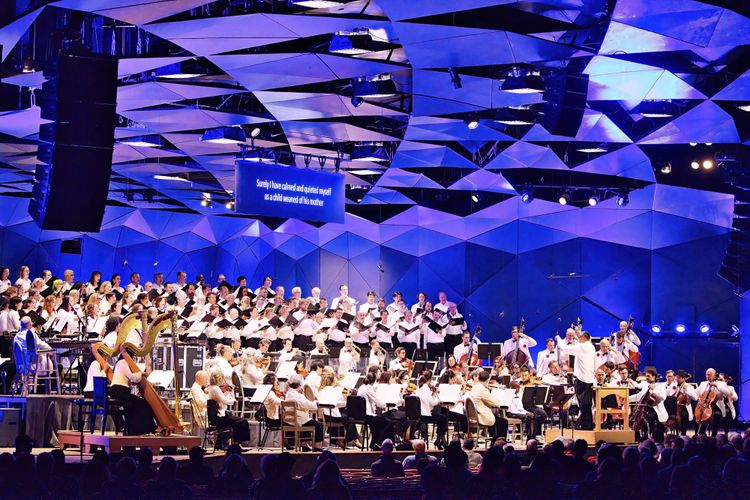
- July 23–27: The Tanglewood music festival runs from July 5 to August 23 (ish — there’s some fuzziness on either side depending on exactly what you count) and includes plenty of post-Romantic music (much of it on the low-profile Sunday morning chamber concerts, many of which are free!), but this weekend in particular is their festival of contemporary music, which features some powerhouses of the contemporary music scene alongside assorted up-and-comers.
- July 30–August 1: For the better part of July, the indispensable Bang on a Can collective will be in residence at Mass MoCA, culminating in this, their celebratory LOUD Weekend. There are performances and workshops through the entire residency, but this is the jam-packed climax with more new work than you can shake a stick at. Their programming tends to be elastic, with pieces added and rearranged to the program with great freedom, so buy a pass and soak up as much as you can.
- August 2–8: Helena Tulve is in residence at the Yellow Barn Music Festival in Putney, VT. Details of specific concert programs are a little scant on the website, currently, but it’s heartening to see a festival devote this kind of sustained attention to a single living composer who isn’t already widely fêted. Tulve is new to me, but I’ve been enjoying digging into her acerbic, snarl-wailing saxophone quartet Öö in preparation.
Phew! There’s plenty to listen to in the coming months, that’s for sure! Maybe I’ll even run into some of you at one of these places or other!
Member discussion