How to Contain the World
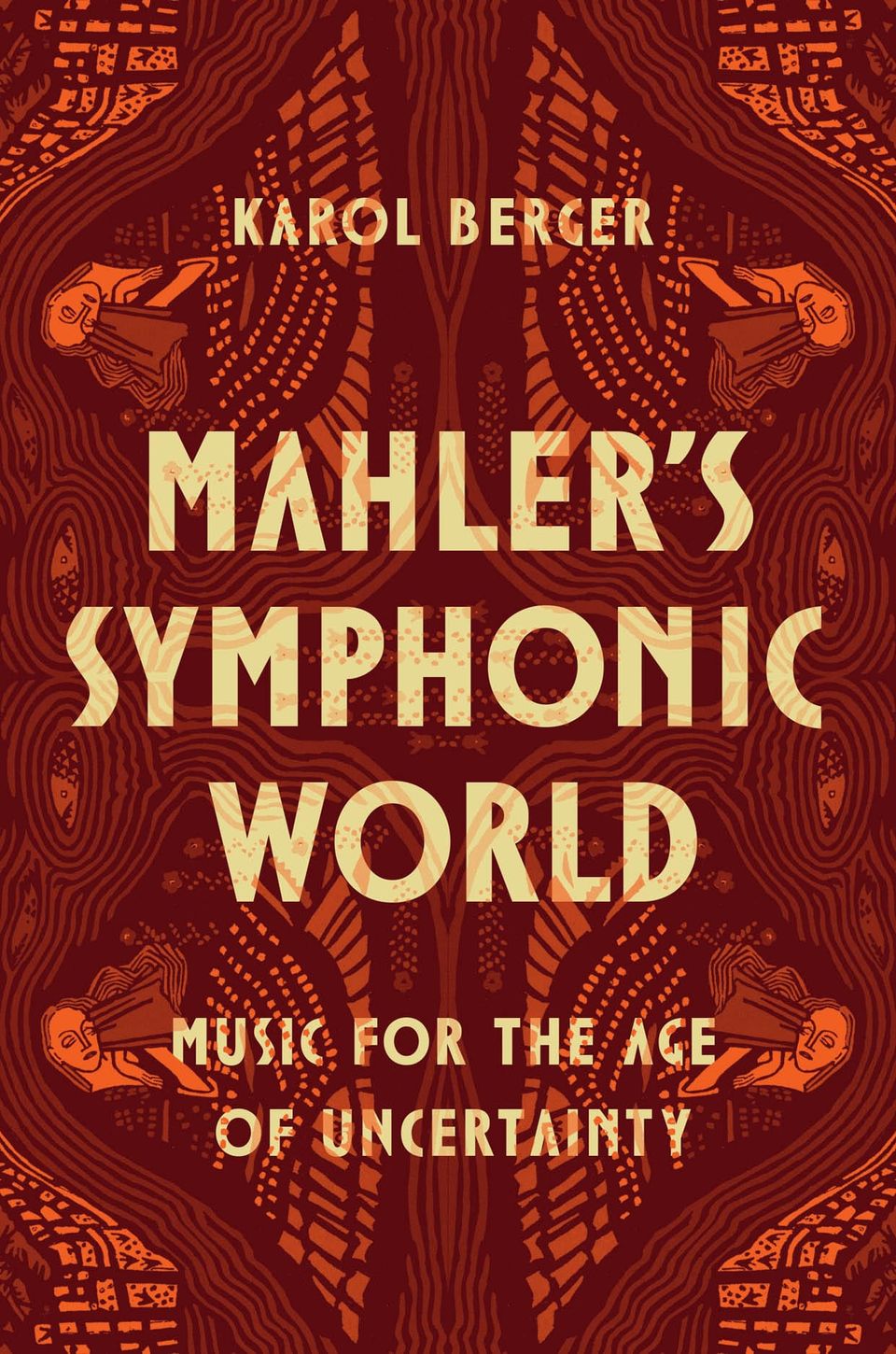
It’s summer, and that means it’s beach read season, and what says beach read like a dense academic treatise on some of the thorniest and most brobdingnagian works in the standard repertoire?
OK, fine. Perhaps Karol Berger’s Mahler’s Symphonic World: Music for the Age of Uncertainty (University of Chicago Press, 2025) isn’t the ideal choice for lightly leafing through while half falling asleep on the shore. Still, if you find yourself with long summer hours to fill and are doughty of heart, it’s an intriguing work that’s mostly worth the time.
I described Berger’s book as an academic treatise, but in truth, his exact intended audience is a little unclear. In the preface, Berger says he is addressing “the general reader with a serious interest in Mahler’s music” even beyond those who are “professional musician[s] or scholar[s]”, and indeed, throughout his analyses of Mahler’s works, he’s careful to provide timestamps to specified recordings so that those who cannot read music can cue up the passage in question and engage directly with the evidence of his arguments. And yet, there’s no getting around the fact that those arguments are densely technical. Even in the passages where he steps out of the musical thicket to discuss Mahler’s broader intellectual context, he does so in uncompromisingly academic ways. At the start of his climactic chapter (to which he directs the general reader in the preface), he summarizes the findings of his earlier analyses in part by saying:
Equally striking and obvious is what might be called the semantic richness of this music, saturated as it is with topical gestures that evoke objects, actions, and ideas we know from our experiences outside music and to an extent not encountered previously in the Viennese symphony, the semantic richness multiplied many times over by the realization that the music speaks in a plurality of voices, that it is “polyphonic” not only in the conventional but also in the Bakhtinian sense. (p 289)
As far as I can tell, this is the first, and only, reference to the Russian philosopher Mikhail Bakhtin in the entire book. Berger does not explain what Bakhtinian polyphony is, and there’s no source for the curious reader to delve into on their own.[1] The book is full of name drops like this.
At the same time, if you, like me, don’t know Bakhtin from bacteria, what is really lost in that sentence? Mahler’s music is polyphonic in the musical sense — it has a lot of simultaneous melodies that retain their individuality even as they twine around each other to build the larger musical texture — and also in some more expansive, metaphorical sense elaborated by some thinker or other. At no point in the pages that follow is it necessary to understand what Bakhtinian polyphony is; the name drop is more of a rhetorical flourish than a critical anchor point, and you can get pretty far through the denser passages by just replacing the unelucidated unfamiliar names with “somebody once told me...”
And you can get pretty far in a direction that, for a fan of this music, is well worth going. My husband bought me this book shortly after it came out last year, because I was frustrated by the relative dearth of writers who even attempt to grapple directly with Mahler’s dizzying formal constructions. At least in what I could find easily online, too many writers seemed content to gesture at some (often dubious) anecdote about the composer’s personal life and then move on, as though knowing that Gustav may once have said that the second theme of the first movement of the sixth symphony represented his wife, Alma, is all that is necessary to explain the full unfolding of that 25-minute behemoth. Berger brings a welcome skepticism towards this biographical trivialization, and his explorations of these symphonies are relentlessly focused on coming to grips with the actual musical material in them.
I’m burying the lede a little here. Berger’s premise is that all of Mahler’s symphonies share a fundamental structural groundplan, each individual work representing one specific instantiation of the composer’s ideal, abstracted symphony. To argue for this claim, he comes at the symphonies sideways: Instead of the usual approach of treating each work in turn, Berger instead groups similar movements together, tackling all the opening movements in one chapter before moving on to all the andantes, then all the scherzos, and finally all the finales.
This is an approach that often bears tremendous fruit. His parallel treatment of the opening marches is a particular triumph, as he teases out conceptual underpinnings that point to an overarching musical philosophy that becomes clear only when the whole body of work is read collectively — it’s an analysis that adds up to more than the sum of his treatment of any one of the movements in question. The philosophical interrelationships between the endings of the second, third, and fourth symphonies are also well-served by this arrangement. If Berger has less to say about the middle movements, it’s also true that Mahler usually has less to say in them; many of his central movements land more as interludes between the massive openings and closings than as critical dramatic turning points in their own right.
Still, this approach also has the drawbacks one might expect. Pulling the movements apart inevitably disrupts the discussion of individual works. This is frustrating enough when it results in things like the analysis of the development of the first symphony’s first movement being postponed some 130 pages until the discussion of the work’s finale, but it can also result in a structural unevenness where the same point is made in multiple places[2] or, conversely, postponed into nonexistence — the treatment of the seventh symphony is so scattered that the work almost evaporates into nothingness. And, too, some of his groupings seem arbitrary, even forced. He divvies the finales up into pairs — the first with the sixth, the fifth with the seventh, the third with the ninth, the second with the fourth.[3] That he feels the need to do so undercuts his central claim that the works all share the same background architecture, and while the pairings themselves basically work, other pairings would too: At the very least, I can imagine it being quite fruitful to pair the second with the third and the fourth with the ninth — but probably one could find interesting parallels between any set of two pulled from a group of eight like this.[4]
This disjointedness comes to a head in the disconnect between the central analytical chapters (the ones that treat each movement of each work in turn) and the final summarizing chapter where Berger situates Mahler in his wider intellectual and cultural context. The middle chapters often feel like they are deferring high-level discussion until the end, instead amassing all the evidence that said final discussion will rest on. The summary chapter, however, mostly leaves all this evidence behind and retreats to general vibes. It feels like the chapter could have been written just the same without all the foregoing analysis, while the analysis ladders up to a final chapter that never arrives. The summary itself is both too long and too short: It is much more than we need to get a general sense of the air Mahler was breathing, but telling a broad intellectual history of Europe in twenty-eight or so pages is overly ambitious, and Berger has to sweep away a tremendous amount of detail behind facile generalizations. I haven’t studied any academic philosophy since my first year of undergrad ended in 2011, but even I found myself going “But wait, what about...” every few paragraphs. After the rigor of what precedes it, it’s a disappointment.[5]
The disappointment is especially sharp because the rigorous middle is so clarifying. The discussions of individual movements may be technical, but they are also exemplary: Time and again Berger tackles movements that seem to resist any formal sense — that seem to be an endless stream of one damn thing after another — and lays bare their inner musical logic. His schematic for the finale of the second symphony may not be the only path through the labyrinth (he is generous in noting where Mahler’s forms are fundamentally ambiguous, impossible to definitively parse in only one way), but it is certainly a clear and compelling thread for the ear to follow when listening. Even in cases like the delirious finale to the sixth when he refrains from offering a final structural verdict, he takes the time to explain just why such a verdict is out of reach, teasing out the dense motivic connections that make it impossible to decide which theme is being developed at certain critical junctures.
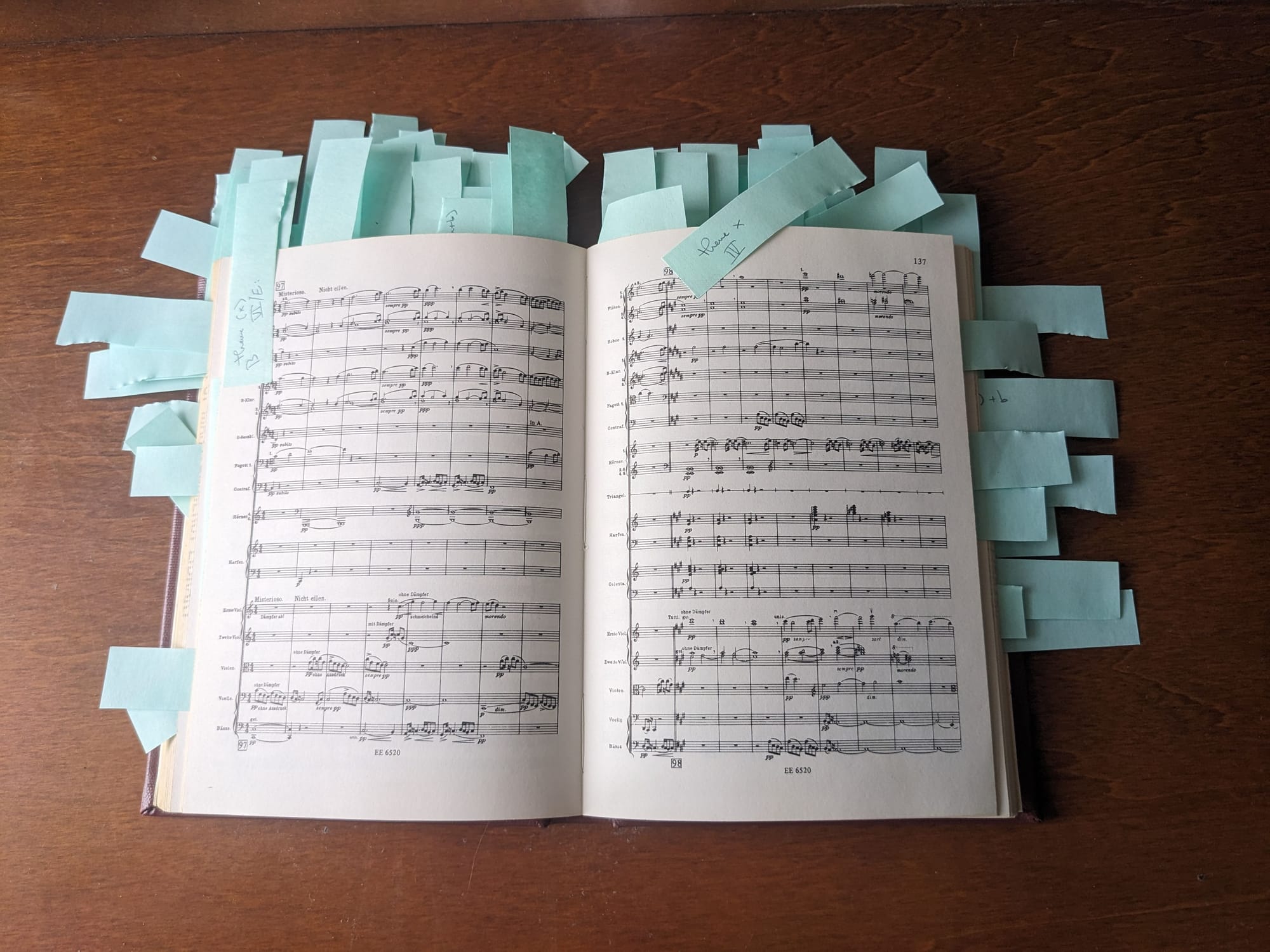
Inevitably, there are quibbles here and there. Overall, the book could have used one more pass by an editor (there are scattered sentences that lose grammatical coherence, a discussion of key relationships in the second movement of the eighth disorientingly conflates B and E major, a few measure numbers in the schematic diagrams seem a little off), and the technical diagrams of each movement, while rich and rewarding to study, are awkwardly laid out and under-explained in the running text.[6] The musical examples are stingy and oddly chosen — a shocking number of them are deployed to illustrate an ultimately rather trivial point about the scherzo of the sixth symphony, while the complex breakdown of the apotheosis at the end of the fifth goes entirely unillustrated, making it quite difficult to follow. I part ways with Berger in several places regarding sonata form,[7] and I’m sure devoted Adorno-heads will find much to gnash their teeth at.
But these are, truly, quibbles. Berger may not have written a perfect book, but he did write a rewarding book. It’s dense going at times, but the effort is worth it. Like one of Mahler’s beloved Alps, the climb is steep, but when the clouds part, heavens! are the views spectacular.
There is an endnote associated with this sentence, but it directs the reader to sources about Mahler’s semantic richness, only one of them in English. ↩︎
Here I am thinking especially of his treatment of Mahler’s Jewishness, which he returns to disjointedly at several points in a way that feels under-consolidated. The discussions themselves are for the most part thoughtful and sensitive; Berger is clearly aware of the trap that comes from either erasing Mahler’s Jewish background (which does seem to have shaped his life and thought in crucial ways) or insisting on it against the composer’s own ambivalent negativity (which feels, in the worst cases, like defining him on the terms of the ardent Jew-haters who gave him so much grief in his day). (This is a trap that attends many assimilated Jewish artists of Mahler’s milieu. I think we haven’t yet figured out the right language to talk about such people; the matter remains difficult.) Still, without being able to provide concrete textual support for this, there are times in these discussions where I found myself unsettled by the feeling of an unexamined assumption of supersessionism lurking under the surface. When Berger writes “we are . . . all Jews on the way to the Promised Land” and suggests that it is a “privilege” for European Jews in the era of the Dreyfus Affair to have easy access to cultural alienation (both p 97), it feels, shall we say, not quite on the mark. ↩︎
He cordons off the two fully vocal symphonies — the eighth and Das Lied von der Erde — in their own chapter, and refrains from discussing any movement of the tenth past its opening. (He in fact maintains that most other movements of the tenth should not be played in concert, which strikes me as a needlessly petty bridge too far.) ↩︎
I find his treatment of the fourth particularly dubious. He insists on joining the third and fourth movements together as a two-part finale, justifying this decision in part on the grounds that “viewing it otherwise would mean that the Fourth would represent the only symphonic work of Mahler with the most weighty movement in the interior rather than at the end of the cycle” (p 230). This comes uncomfortably close to the circular argument that there can’t be a counter-example to Berger’s thesis (that Mahler wrote finale-oriented symphonies that share a common structure which places most of the emphasis on the last movement), because then his thesis would be false. (I also think there is an argument to be made that the seventh, similarly, resolves its fundamental musical/philosophical issues in its penultimate movement, leaving the finale as a kind of release or endcap, and that this is a resolution that is really only visible in the context of the work as a whole, invisible when that penultimate movement is extracted and treated individually, but this is a subtle, difficult argument, and I don’t insist on it.) ↩︎
It doesn’t help that Berger devotes so much of this chapter (and the book as a whole) to sparring with Adorno. It is perhaps de rigueur for an academic writing about Mahler for an academic audience to grapple with that heavyweight, but for a general audience, it’s a misstep, especially since, as is his wont, Berger spends so little time laying out Adorno’s positions for those unfamiliar with them. Here, at least, Berger is generally clear about the works he’s referencing so the curious reader can seek them out to get the full context, but there are times where the book starts to feel more centered on Berger’s beef with Adorno than about the composer whose name is in the title. ↩︎
I generally consider myself to be pretty adept at formal analysis, but even I confess to being unclear about exactly what difference (if any) Berger is getting at by identifying some sections of the finale of the fifth as presenting themes “3” + (“2”) vs “3 + (2)”, to say nothing of the frightful constructions like (y)b(+2) that dot the schematic of the last movement of the sixth. The small letters sometimes seem to refer to motives that span an entire symphony, but sometimes also seem to be confined to one movement, or even one theme — though it is possible, of course, that here I am being led astray by an unsophisticated ear and missing out on the very connections that Berger is trying to draw my attention to! ↩︎
There is really no way to discuss this without getting quite technical, so I’m sequestering this down here in a footnote. I’m going to do my best, but if at any point your eyes start glazing over, just skip back to the main text.
What makes the sonata-form issue so vexatious is that the history itself here is rather convoluted. Sonata form emerges gradually in instrumental works of the early 1700s, reaching its quintessential form by the 1760s, at which point it becomes the strong normative default structure for the first movement of instrumental compositions well into the 20th century. It takes some time, however, for theorists to start codifying and analyzing the form, with much of the groundbreaking work here being done by AB Marx in the 1830s and beyond. In line with much music theory at the time, Marx is strongly interested in being prescriptive, telling his readers not just how sonata form has been written in practice but how he thinks it ought to be written in theory.
As such, his work is not always a very good guide to the music he purports to be analyzing, but, because his books were hugely influential, it becomes a good guide to the music written by composers trained on his teachings. This creates a paradoxical situation where his works are a better guide to music he wasn’t analyzing than music he was, and also means that analytic models more finely tuned to the works of the late 1700s and early 1800s sometimes break down when applied to music written 100 years later. At the same time, many composers have always learned their craft by studying the works of their predecessors, and if you model yourself very closely on Beethoven, you will wind up writing like Beethoven, regardless of what the intervening theory textbooks say you “ought” to be doing. So those tuned-to-early-sonata-form models wind up being not quite so useless at the fin du ciècle after all.
One such model is the one developed by James Hepokoski and Warren Darcy in Elements of Sonata Theory (Oxford University Press, 2006). I studied with Hepokoski during a deeply formative period in my musical life, so it’s small wonder that I find his approach deeply compelling. I’m not a scholar of sonata form; my impression is that Elements led to something of a revolution in the field, but it’s possible this is overstated hype from the Hepokoski fan club that was inescapable in my undergraduate music department. Either way, Berger does not seem to be engaging with Hepokoski and Darcy’s model, which leads to the parting of the ways I’m describing.
To take just one example, Mahler often omits the second theme of his sonata-form movements from the development section, and Berger repeatedly points to these omissions as evidence that said second themes are not fully integrated into their musical surroundings, visions of the beyond more than key parts of an unfolding whole. But from a Hepokoski-and-Darcian perspective, this is exactly what we should expect: Of all possible themes in a sonata-form movement, they find that second themes are by far the rarest themes to be used in a development section. On pp 205–6, they write:
While [the second theme] does appear in many developments and even dominates some, it may be that its relative infrequency is related to its cadentially “sensitive” role in the exposition. To allude to [the second theme] might be to call up connotations of its seeking the proper tonal “track” on the way to the [essential structural harmonic closure] (something that can normally happen only in a recapitulation). . . . since [other themes] are “inert” in the sense that by definition they cannot bring about the eventual [essential structural closure], they are particularly suited to dominate developments.
This gets at one of Hepokoski and Darcy’s sharpest theoretical interventions: While older theorists tended to frame the first theme as dominant or active and the second as passive (frequently leaning into a wholesale gendered dichotomy between “masculine” and “feminine” thematic types), Hepokoski and Darcy understand the second theme as the more harmonically potent one: It is the one that does the fundamental musical work of the sonata, driving it to its ultimate harmonic goal.
As I said, however, the situation of fin du ciècle works is complicated, even paradoxical. There are absolutely times when Mahler’s second themes seem to be fundamentally passive visitors uninvolved in the propulsive musical goings-on that surround them, but there are also times (the third symphony being perhaps the parade example) when they are forward-driving forces that do heavy musical work indeed. I think there are times when Berger’s reliance on older paradigms of sonata theory obscure his understanding of the rhetorical workings of some of these movements. But again, this is a quibble, and the whole thing is rather fraught. ↩︎
In Brief
Mine has been a house of sickness of late, so I haven’t gotten out and about as much as I normally do. Still, I don’t want to leave you with nothing to listen to, so here are a couple of things that have been filling my ears between benadryl naps. First, I’ve been enjoying getting to know Kate Soper’s Romance of the Rose. I haven’t been able to spend enough time with the text to feel grounded enough for a formal review, but what strikes me is that along with the usual Soperian self-referentiality, the music seems genuinely willing to commit to something that isn’t (until perhaps the spoken epilogue?) undercut by self-aware irony. Along the way, it feels like it manages one of the most difficult tasks there is: writing a new kind of love song.
Second, in a time of seemingly omnipresent cruelty and violence, I have found Rahilia Hasanova’s Monad a strange sort of balm — not a consolation, exactly, but a place of honesty, where I don’t feel any need to set aside my rage and grief and horror. Ju-Pin Song’s performance here is ferocious; she pushes this brutal score relentlessly forward until it feels like the whole world is being swallowed up by its pitiless vortex. If, like me, you have also been in the abyss in recent days, clamber on in — there’s plenty of room for us all in the void.
In My Calendar
The June lull continues apace, but summer offerings are beginning to pick up, including the events below. As ever, this set of listings is not comprehensive; it’s just what happens to be on my radar that I’m particularly excited about. If you are a performer, presenter, or publicist in the local classical music scene, please add me to your mailing list so I can keep an eye out for your offerings!
Entries marked with a ∅ are free and do not require advance registration.
- June 21, 3:00pm: The Euclid Quartet brings Florence Price’s string quartet to Music Mountain, in northwestern Connecticut. There’s also something by some guy named Brahms, I guess, but really, after Price, what further enticement could you need?
- June 26–28, various times: The New Directions Cello Festival comes to downtown Florence for three performances at the Bombyx center. (There are livestream tickets for the Friday and Saturday shows, and the Sunday concert is free!) Most of the names here are new to me (I confess to not being a particularly encyclopedic contemporary cello maven), but the culminating big band sounds like it’ll be an awful lot of fun, and I’m very intrigued by many of the other names in the interim.
- June 28, 3:00pm: If my description of Maurice Ravel’s 1903 string quartet back in the very first issue of this newsletter made you desperate to hear it live, you’re in luck! The Balourdet Quartet bring that work to Music Mountain along with Nicky Sohn’s delightfully titled Galaxy Back to You. (There is also, inevitably, more Brahms.)
Member discussion