To Fugue or Not to Fugue
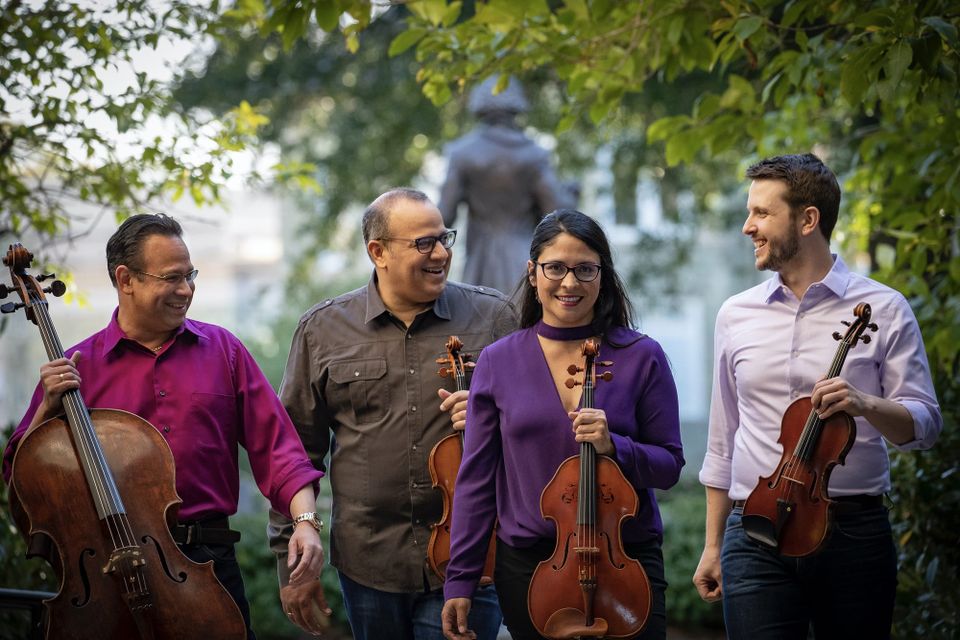
In Review: The Dalí Quartet
There is a moment in the first movement of Ludwig van Beethoven’s thirteenth string quartet where the propulsive logic of tonality breaks down into a static series of oscillating chords. Their frozen harmony doesn’t settle firmly into the G minor of the melody twining sensuously around them, leaving the whole thing with a dreaminess that would fit right into one of Astor Piazzolla’s more sweetly nocturnal passages.
That connection is one I doubt I would have made before Thursday evening’s performance by the Dalí Quartet at The Hartt School.[1] The group seeks to put Latin American string quartet music on equal footing with the European canon; on this occasion, that took the form of pairing three Latin American works on the first half with Beethoven’s thirteenth on the second all by itself.
The evening opened with a piquant rendition of Piazzolla’s 1956 Tango Ballet. With its snappy rhythms and wry melodies, it’s a piece with tremendous emotional range, and the Dalí members swung from one extreme to the other with palpable glee. Silvestre Revueltas’s angular second string quartet, Magueyes[2] (1931), followed. Its three austere movements share musical material; the first is the strongest to my ear and says with greater clarity everything the other two repeat.
Sonia Morales Matos’s Divertimento Caribeño 3 (2018) closed out the first half. In keeping with its title, it’s a lighter work, surrounding a melancholy bolero with two dance movements. The expressive central song welcomed sorrow in as a guest, sitting with it without any need to move beyond it; the opening merengue was full of intricate metrical play, but its reprise as the finale felt oddly verbatim, untransformed by the somber center.
Going in, I was curious how the Dalí Quartet would tie Beethoven to Latin American composers of the last hundred years. The works on the first half all build musical structures from motivic fragments; perhaps they would emphasize the atomization that Beethoven sometimes subjects his melodies to?[3]
In the event, this turned out not to be the case. They played Beethoven as Beethoven. In itself, this was impressive — switching from the burly extroversion the pre-intermission pieces required to the dulcet restraint that befits the 1820s is no mean feat, and the players carried it off with grace. Still, by playing true to genre, their playing felt a little, well, generic, though they brought out a friendly warmth in the dance movements. Unlike the ferocious specificity of their playing in the first half, their interpretation had a pro-forma air, as though the Beethoven had been thrown in solely to draw a crowd.
Perhaps the economics of concertizing require that, but I couldn’t help wishing for the version of this bill that left Europe behind entirely. What three-quarters-of-an-hour-long Latin American quartets, extant or waiting to be commissioned, could benefit from the vibrant attention of players this strong? I have little doubt I will hear the second half of this concert many times in my concert-going life. My fear is that I will never hear the first half again.
The quartet’s usual violist, Adriana Linares, was unable to join them, so their lineup here was Ari Isaacman-Beck and Carlos Rubio on violins, Jaime Amador on Viola, and Jesús Morales on cello. ↩︎
Maguey is another name for the agave plant. ↩︎
Easy examples to cite include the crystalline evaporation of the last movement of his last piano sonata, or the proto-minimalist dissolution of the second movement of his fifth symphony, though other instances abound. ↩︎
Also Heard: 4x4 Quartets
TS Eliot’s connection to music goes far beyond CATS. Four Quartets, one of Eliot’s last major works, alludes to the genre of the string quartet, and his letters make it clear that Beethoven’s late quartets — especially the 15th (in A minor, opus 132) — held a key place in his life. It seems natural, then, to bring the poems and the music together, to see what insight is gained by the juxtaposition.
On Sunday afternoon, Quartetto Mosso and Marty Kluger executed this concept at Smith College’s Sweeney Concert Hall, the quartet playing selected movements from four Beethoven quartets alternating with Kluger reading excerpts from sections of Four Quartets. And by executed, I mean both that they did it and that they did it in.
Eliot’s poetry has an undercurrent of fervid urgency, but he often covers it with mordant urbanity, as though hedging his emotional bets. (Perhaps it is this detachment that let him praise Emanuel Litvinoff’s scathing attack on his antisemitism when Litvinoff read it to his face.) This is a difficult mark to hit, and Kluger did not seem to be aiming at it. His readings were ponderous and hammy; when he clutched his chest and staggered to East Coker III’s opening “O dark dark dark”, I struggled to maintain my composure. (Kluger is, among other things, a barbershop quartet singer, and his was, bewilderingly, a very barbershop take on Eliot. Maybe you could spin this as a Midwestern revenge on Eliot for his snooty self-Anglicization, but nothing else suggested they were taking the piss out of him like that.)
Still, that’s mostly a matter of taste, and Eliot’s poems work better on the page than in the ear anyway. How was the music?
The first selection, the slow fugue that opens the C# minor opus 131, started promisingly, with celestially sweeping phrases, but problems of intonation, cohesion, and shape soon emerged that plagued the quartet to the end. Entire movements lacked a clear structural arc; the playful hocketing[1] of the Heiliger Dankgesang[2] mostly failed to mesh; even immediately after re-tuning, the opening chord of the E-flat major quartet’s first movement was just as sonically curdled as what had come before.
These issues came to a head with the Große Fuge, the angular behemoth that served as the original finale to the thirteenth quartet.[3] Even when played with pinpoint accuracy, its snarling dissonances and frenetic offbeat accents make it sound like the ensemble is on the cusp of falling apart at the seams; here those seams repeatedly came fully undone, leaving only a calamitous muddle.
Despite all this, they did convince me there’s a fruitful linkage here. In particular, there is something in the different approaches these two artists take to meditative cycles: Eliot obsesses, returning again and again to an image, an idea, a line, changing without progressing. Beethoven ruminates, but one thought always leads to another; his work pushes relentlessly forward. There is more to mine here, to be sure. What a pity these forces were not able to find it.
Hocketing is a musical technique that takes a rhythmic figure and splits it up between different musical voices that fit together like puzzle pieces or the interlaced fingers of lovers holding hands. ↩︎
The “Holy Thanks-song” that is the third movement of the 15th quartet (A minor, op 132). ↩︎
I am increasingly in agreement with those who think that the fugue should be restored as the last movement to that quartet in lieu of the lighter finale that Beethoven wrote to appease his publisher, though I recognize this is an opinion that means I can be hunted for sport by the Society for the Prevention of Cruelty to String Quartets. The cavatina picks up on the moment of strange harmonic stasis from the opening movement and widens it into a doorway; what’s on the other side of that door needs to be strange and terrible — the Große Fuge is that in a way the rondo simply isn’t. ↩︎
In Brief
It was a major week for student performances at local colleges. In keeping with my policy on student performances, I’m not going to be writing formal reviews of these, but I do feel I have to give a shout-out to the Amherst College symphony orchestra for tackling Gustav Mahler’s sprawling sixth symphony and to all the UMass performers, student and faculty alike, who participated in the wide-ranging Joan Tower celebration.[1] In particular, I was touched that Amherst made their Mahler hammer out of a salvaged local tree, and I was delighted to be introduced to Tower’s Black Topaz, an early work that feels like a cipher key to her sometimes elusive musical language. I’m giving a big round of applause to you all!
As ever: I am employed by UMass, albeit not in any capacity related to their music department or the Fine Arts Center. ↩︎
In My Calendar
This set of listings is not comprehensive; it’s just what happens to be on my radar that I’m particularly excited about. If you are a performer, presenter, or publicist in the local classical music scene, please add me to your mailing list so I can keep an eye out for your offerings!
Entries marked with a ∅ are free and do not require advance registration.
- Ø April 7, 7:30pm: Katelyn Burns (flute) gives her UMass faculty recital with Steven Beck on piano. Repertoire ranges from the Baroque to the present day, and there’s even a livestream.
- April 8, 7:30pm: The UMass Wind Ensemble and Symphony Band give their Spring concert. A few warhorses of the standard repertoire along with some newer fare, including a work by one of the ensembles’ conductors.
- Ø April 10, 7:30: Robyn Quinnett and Jiayan Sun play a variety of violin/piano duets. The full program isn’t listed, but from the details they do have, I’m almost certain they’ll be playing Olivier Messian’s Theme and Variations — a gorgeous piece in its own right, but also an illuminating bridge from more traditional harmonies to his own ecstatic musical language.
- April 10–12, various times: The Hartford Symphony Orchestra plays Clarice Assad’s piano concerto with Assad herself as the soloist. Also, they’re doing some Brahms.
- Ø April 12, 3:00pm: Ensemble Télémanque presents Sounds, Tears, and Skins at Bombyx in Florence. Four new works for voices and chamber ensemble tracing themes of marginalization and migration in the lives of 20th-century literary figures. There’s a pre-concert talk at 2:00 for those who want to dive deeper into the works.
- Ø April 16, 7:30pm: The Yale School of Music livestreams a concert of the music of Aaron Jay Kernis. (Obviously you can also go in person, but I suspect it’s a little far afield for many of you!) Kernis’s works are very lush while simultaneously being very austere, a combination that beguiles me and that pulls me back time after time in the hopes of one day more fully understanding it.
- Ø April 17, 7:30pm: The Williams College Percussion Ensemble gives their spring concert. No specific details on the repertoire, but one of the joys of college percussion groups is that they often have the ability to put on the kind of instrument-heavy works that are impractical for independent groups that don’t own entire buildings in which to keep rarely used drums and gongs and particularly resonant fragments of flowerpots, so expect at least one thing you’re unlikely to be able to hear anywhere else.
- Ø April 18, 4:00pm: Smith Gamelan celebrates 30 years of making Javanese music in Hampshire County. The whole event lasts five hours, but you can come in and out at your pleasure, and it sounds like there will be light refreshments of some sort.
- April 18, 7:00pm: Bombyx hosts two all-star klezmer groups. Linear augmented seconds are sure to abound!
- Ø April 19, 2:30pm: The UMass graduate wind quintet play works from the 19th and 20th centuries. I’m not sure which of Françaix’s two quintets they’ll be doing, but the good news is they’re both an absolute ball, so either way you’re in for a good time.
Member discussion