The Story of a Book
In Review — Trobár: Songbook for a King
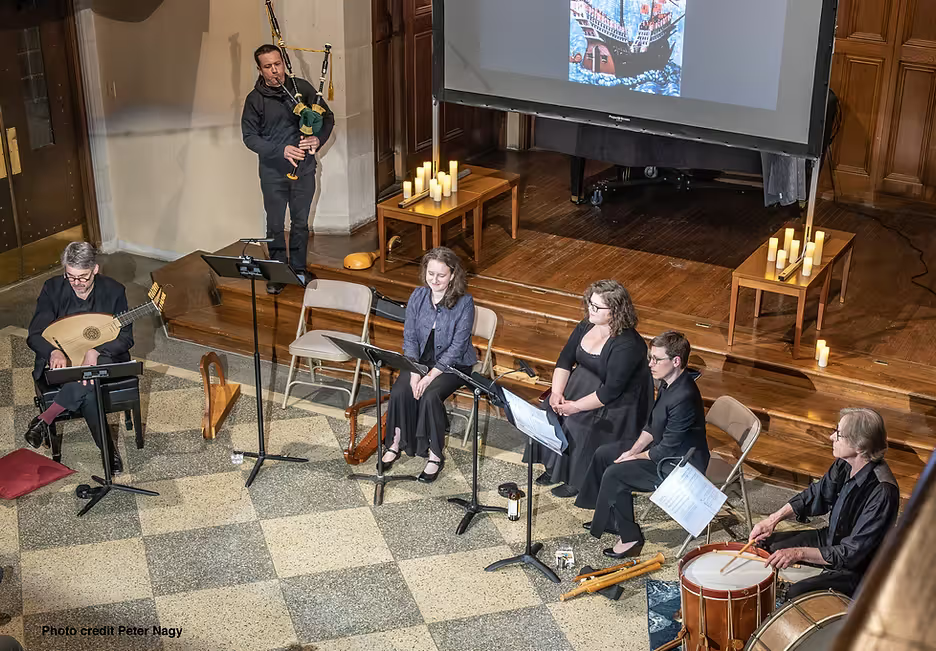
“It all started with a cow...” Thus one of many slides projected over the Medieval musical ensemble Trobár this past Saturday at UMass’s Bezanson Recital Hall[1] as they presented selections from the Chansonnier du Roi, a multi-layered musical manuscript spanning the thirteenth to fifteenth centuries in what would come to be France. The original manuscript has had many additions and deletions: an initial compilation around 1250, substantial new material written in around 1275, various add-ons in the 1300s, and numerous cases of removed illustrations taking the music on their other sides along with them into oblivion.
What remains is a strikingly broad compilation that serves as our only record of many Medieval poems and songs, a key source for our understanding of the music of its time and place. Trobár presented five sets of works from the book arranged in chronological order, with the slides behind them providing context to guide us through the evening as well as translating the lyrics. The context-setting sequences were underscored by some of the Chansonnier’s instrumental entries, which gave the evening a terrific, guided flow — this setup provided a great deal of information without having to constantly stop the show to lecture the audience.
Trobár is a flexible ensemble, with different projects of theirs calling for different forces. In this instance, the lineup comprised Allison Monroe (their artistic director) on strings, Nathan Dougherty and Karin Weston on voice, Allen Otte on percussion, and Sian Ricketts on winds and voice. Together, they created a surprisingly rich sound — more than once, I found myself trying to pick apart what I was sure was a dense harmony only to realize there were only one or two pitches sounding, each player’s small differences in expression and ornamentation adding holographic depth to the melody, like a murmuration of sparrows all heading in the same direction without any two birds following exactly the same path.
The melodies themselves were lithe and winsome, and the singers delivered them across the board with emotional directness — think Gregorian chant meets indie folk-pop. This directness spanned the somber to the silly: Westin embodied a woman bereft at her husband riding to war to devastating effect, while Dougherty carried one of the comedic numbers by skipping around the auditorium in imitation of a knight fleeing a bungled seduction on horseback.
Much of this music is alien to the modern ear, but the chronological presentation brought out the differences across the span of the Chansonnier’s contents. After the ornamentation of the 1270s, the 1300s arrived with an austere shock. In the epilogue, the troupe burst forth in a firework of 1400s polyphony. The counterpoint may have been simple compared to the intricacies that would come in the 1700s, but in the context of what had come before, it felt like a whole world cracking open, a universe of sound rushing to be born, ushering us out into the glittering night.
As ever, an obligatory disclosure that UMass is my primary employer, though my work for them is entirely unrelated to the music department and its offerings. ↩︎
In Brief
On Sunday evening, Ryan Bisson, Robert Stahley, and William Braun presented an evening of works for bass trombone, tenor, and/or piano linked by the First World War — settings of texts by poets who lived through the War or wordless offerings by composers who shared that fate. The linkage was sometimes diffuse: William Grant Still’s elegant Romance from 1966 seemed far removed from his 1918 Navy stint; the program concluded with Bisson’s own setting of Joy Harjo’s “This Morning I Pray for My Enemies”, though he was born in 1992 and she in 1951. (The setting had the beguiling discombobulation of a Beethoven andante that had been taken apart for maintenance and reassembled with some of the parts in not quite the right place.) The heart of the show was Hutson Rollins and Ben Dondanville’s harrowing setting of TS Eliot’s Hollow Men, which deployed the Wagnerian heft of Stahley’s tenor to appropriately dramatic effect.
For reasons that need not detain us, I’ve recently been revisiting Axis Mundi, a cacophonous work for solo bassoon by Australian composer Liza Lim. There’s no shortage of composers who turn to simple melodies and consonant harmonies to depict the natural world, but it’s always seemed to me that the rules of tasteful harmony are artificial constructs of human societies and that nature should be voiced with more raucous anarchy. Lim’s evocation of the cosmic World Tree certainly fits that bill — Axis Mundi contains almost no ordinary pitches, instead sliding around in a world of unstable, crackling groans and tremors. There’s a thunderous recent recording of it on Bandcamp by Ben Roidl-Ward, himself a tireless champion of all the strange sounds it’s possible to extract from a bassoon — play it loud as the churn and thaw of March gives way to the buzzing new life and growth of Spring.
In My Calendar
This set of listings is not comprehensive; it’s just what happens to be on my radar that I’m particularly excited about. If you are a performer, presenter, or publicist in the local classical music scene, please add me to your mailing list so I can keep an eye out for your offerings!
Entries marked with a ∅ are free and do not require advance registration
- ∅ March 25, 7:30pm: Boris Berman plays John Cage’s Sonatas and Interludes for prepared piano (only the livestream is free). The Cage work is a landmark in its own right, but it’s also one of the pieces that pushed him to embrace indeterminacy, since no two prepared pianos sound exactly the same way.
- ∅ March 30, 7:30pm: UMass celebrates iconic American composer Joan Tower with a concert of various chamber works. If you’re free earlier in the day, Tower herself is giving a lecture at 11:00am that morning. Come early if you can; it’s sure to be packed.
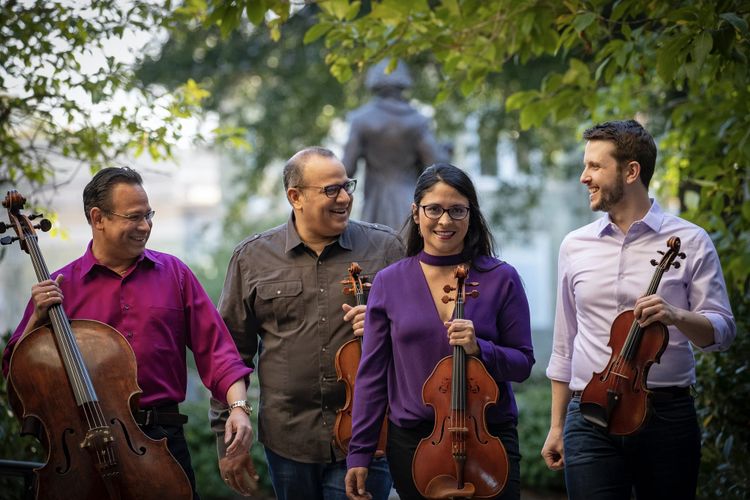
- April 2, 7:30pm: The Dalí Quartet visits the Hartt School for a combination of Latin American string quartets and Beethoven’s thirteenth work in that genre. The website doesn’t provide a full list of works, but given what I know of Piazzolla and Revueltas’s oeuvres, I expect an evening of craggy rhythmic forcefulness, especially if the quartet includes Beethoven’s skittering, monumental Große Fuge.
- ∅ April 4, 7:00pm: The Amherst Symphony Orchestra performs Gustav Mahler’s sixth symphony. Which order will they do the middle movements in? Only one way to find out!
- ∅ April 5, 3:00pm: Smith College hosts a program joining Beethoven’s late string quartets and TS Eliot’s final poems. I don’t know exactly how this is going to work, but the concept tickles me.
Member discussion