String Quartets and Saxophones
I was hoping to anchor this inaugural newsletter on an intriguing concert centered around music and poetry shaped by the First World War, but that concert was postponed until the 22nd (see the listings below!), so instead, here’s a look back at a slightly less recent show.
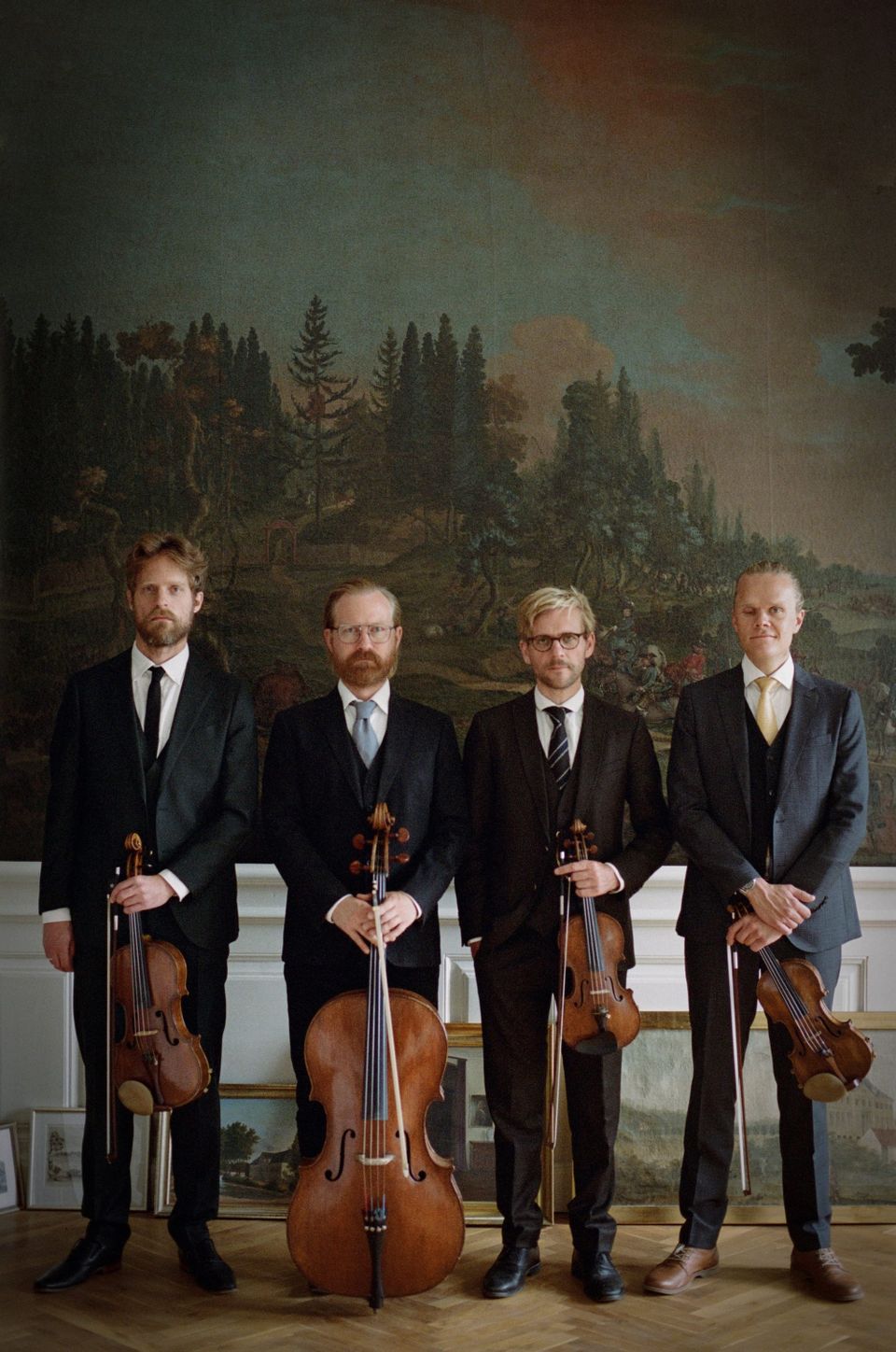
In Review: The Danish String Quartet
For a time in my life, I could not escape Maurice Ravel’s 1903 string quartet in F. The work is within the grasp of good high school or undergraduate players, and its winsome melodies, tart harmonies, and rugged rhythms make it a deserved hit with performers and audiences alike. Small wonder, then, it cropped up on many a summer music camp bill; hearing so many renditions of it in such short succession was an early education in how the same score can inhabit different emotional worlds when interpreted by different groups.
In the hands of The Danish String Quartet at Amherst College’s Buckley Recital Hall, the piece was a rambunctious affair, full of tumultuous vim. The February 21 concert was part of an extended tour, but the group showed no signs of road weariness: The scherzo’s pizzicato passages were crisp and punchy; the finale had an irresistible barn-burning burliness. This was an effusive, hyper-emotional rendering of Ravel, which had ups and downs. The slow third movement was robbed of some otherworldly mystery; with all its secrets laid bare, it was a lily not just gilded but airbrushed too. But Asbjørn Nørgaard, on viola, brought a particular aching sweetness to the first movement’s nocturnal second theme, in a line that can easily turn into mere background to the first violin.
The coolness I sometimes missed in the Ravel was on full display earlier with Jonny Greenwood’s suite from his soundtrack to There Will Be Blood (2007). Like many concert arrangements of movie music, the suite couldn’t quite shake the impression that it was meant to be playing while something absent took center stage, but still, the quartet brought a glassy unity to Greenwood’s dust-swept melodies and intricately menacing musical machines.
Perhaps the Greenwood suffered from coming second on the program, directly after Alfred Schnittke’s apocalyptic second string quartet (1981), a piece that demands absolute attention. Written in memory of Larrissa Shepitko, a friend and collaborator who died in a car accident in 1979, Schnittke’s second quartet is a howl of despair amassed from monolithic walls of dissonance and inscrutable echoes of Russian Orthodox chant. Many memorial works move towards consolation in their final passages, closing the book on grief and leaving the audience at a point of repose. Not so the Schnittke, which sits with grief without any expectation of resolution.
The quartet’s traversal of this hard landscape was breathtaking. The wayward counterpoint that opens the work was haunting; the frenzied, asynchronous arpeggios of the second movement melded seamlessly together as though emanating from a single impossible instrument; and the final stratospheric whispers of the Orthodox chant were immaculately chilly. A current of burning love ran throughout; its intensity and depth animated every moment and gesture. Other performers have spun this music differently, but here it was a profound exhortation to choose life and connection even if they give death a harsher sting.
In Brief
Jonathan Hulting-Cohen is an old and dear friend and colleague, but it’s been well over a decade since I’ve heard them live in person, so their recital on March 1 at UMass Amherst’s Bezanson Recital Hall[1] was a chance to be impressed anew by their silvery timbre and pinpoint precision. (Jiayan Sun, the guest pianist for the show, is no slouch either, and the two had an impeccable ensemble balance and unity of expressive purpose.) Perhaps because I was in the teeth of a migraine, I struggled with the form of some of the works on offer, but especially in the trembling ecstasies of Takashi Yoshimatsu’s Fuzzy Bird Sonata, my notes are filled with comments that, with tone and phrasing this delicious, it was simply impossible to care — I would listen to this duet play the phonebook.
The other day, I caught just a snippet of an unknown-to-me violin concerto on the local classical music station. It turned out to be Gabriela Ortiz’s violin concerto, Altar de Cuerda, performed by Susie Park and the Minnesota Orchestra led by Paolo Bortolameolli. Happily, the full performance is free for all to watch on YouTube. The second movement, with its floating solo lines and abstract-yet-tender chiming harmonies is the one that caught my ear in the car, but on repeat listenings, I’ve been especially captivated by the way the cadenza in the third movement manages to shift in the space of a single arpeggio from modernist angularity to Romantic lushness to the twang of an Appalachian fiddle.
In line with my policy in such cases, here is an obligatory disclaimer that I am employed by UMass Amherst, albeit not in any capacity related to the music department and its offerings. ↩︎
In My Calendar
This set of listings is not comprehensive; it’s just what happens to be on my radar that I’m particularly excited about. If you are a performer, presenter, or publicist in the local classical music scene, please add me to your mailing list so I can keep an eye out for your offerings!
Entries marked with a ∅ are free and do not require advance registration
- March 13–15, various times: The Hartford Symphony Orchestra plays *The Pines of Rome* as well as a tone poem by Gabriela Lena Frank. Not exactly in my backyard, but Frank is always worth hearing, in my experience.
- March 15, 3:00pm: The New England Philharmonic presents New Music New England a concert of world premieres at Boston University. I obviously don’t know any of the music, but Gloria Chang is a reliable powerhouse on the piano.
- March 19, 7:00pm: The Springfield Chamber Players present an evening of string trios at the Westfield Athenaeum. Mostly not new music, but consider this part of my propaganda to convince everyone that the Goldberg Variations work better for string trio than keyboard.
- March 21, 3:00pm: A Far Cry, an endlessly inventive chamber orchestra, comes to Smith College for a concert ranging from Beethoven through Copland to a piece by my acquaintance Shelly Washington. If you can come an hour early, there’s a pre-concert discussion at no extra cost.
- ∅ March 21, 7:00pm: The Trobár Medieval Music Ensemble presents Songbook for a King, their take on a unique Medieval musical manuscript. How often do you get to hear selections from the Manuscrit du Roi?
- ∅ March 22, 4:30pm: Two UMass alums return for a set of music and poetry shaped by the First World War. I don’t entirely know what to expect from this one, which is one of the most exciting things I can feel about an upcoming concert.
Member discussion